
Memorizing key signatures, so that you know at once that three sharps means A major or that two flats means B♭ major, looks like brute-force work, but a few tricks make it almost automatic. Here are the most useful ones. For the background theory, see keys and key signatures.
1. The order of sharps and flats
Sharps always appear in this fixed order:
F – C – G – D – A – E – B
And flats appear in the reverse order:
B – E – A – D – G – C – F
The trick to remember it: the order of sharps is a chain of ascending fifths (F up to C is a fifth, C up to G is another fifth, and so on), and the order of flats is a chain of descending fifths. In other words, it is the circle of fifths itself. We go into detail in order of sharps and flats.
If you prefer a mnemonic, a very common English one for the sharps is "Father Charles Goes Down And Ends Battle" (F C G D A E B). For the flats, say it backwards: "Battle Ends And Down Goes Charles's Father" (B E A D G C F). The first four flats also spell the word BEAD.
2. Finding the MAJOR key from the key signature
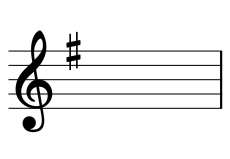
If the key signature has sharps: look at the last sharp and go up a half step (UK: semitone). That is the major tonic (the last sharp is always the leading tone (UK: leading note), a half step below the tonic).
Example: a key signature with F♯, C♯ and G♯. The last one is G♯, and a half step above it is A, so the key is A major.
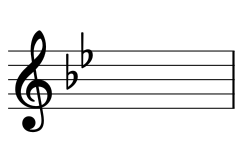
If the key signature has flats: the major tonic is the second-to-last flat.
Example: a key signature with B♭, E♭ and A♭. The second-to-last is E♭, so the key is E♭ major. (The only two you have to memorize separately are C major, with no accidentals, and F major, with a single flat.)
3. And the MINOR key
Every key signature serves a major key and its relative minor, which share the same accidentals. The relative minor is a minor 3rd below the major tonic (3 half steps down), which is the same as its 6th degree.
Example: if the key signature is A major, its relative minor is F♯ minor. There is more on this in keys.
Chart of all key signatures
For a quick look, here are the 15 key signatures with their major key and relative minor:
| Accidentals | Major key | Relative minor |
|---|---|---|
| None | C major | A minor |
| 1 ♯ (F♯) | G major | E minor |
| 2 ♯ (F♯ C♯) | D major | B minor |
| 3 ♯ (F♯ C♯ G♯) | A major | F♯ minor |
| 4 ♯ (+ D♯) | E major | C♯ minor |
| 5 ♯ (+ A♯) | B major | G♯ minor |
| 6 ♯ (+ E♯) | F♯ major | D♯ minor |
| 7 ♯ (+ B♯) | C♯ major | A♯ minor |
| 1 ♭ (B♭) | F major | D minor |
| 2 ♭ (B♭ E♭) | B♭ major | G minor |
| 3 ♭ (B♭ E♭ A♭) | E♭ major | C minor |
| 4 ♭ (+ D♭) | A♭ major | F minor |
| 5 ♭ (+ G♭) | D♭ major | B♭ minor |
| 6 ♭ (+ C♭) | G♭ major | E♭ minor |
| 7 ♭ (+ F♭) | C♭ major | A♭ minor |
4. The circle of fifths: the map that sums it all up
If you memorize only one thing, make it the circle of fifths. Moving clockwise adds one sharp at each step (C→G→D→A…), and moving counterclockwise adds one flat (C→F→B♭→E♭…). With it you have all 15 keys in view, with their key signatures and relative minors. It is the best cheat sheet there is.
5. A trick for building any major scale
You do not need to memorize the notes of every scale. The pattern of whole steps (W) and half steps (H) of the major scale is enough:
W – W – H – W – W – W – H
(UK: tone and semitone, T–T–S–T–T–T–S.) Apply that pattern from any note and you get its major scale with the right accidentals. You will find examples in major scales, and the other scales in types of musical scales.
With these five tricks, reading a key signature stops being a puzzle. Practice by finding the key in any scores you have at hand: within a week you will do it at a glance.