
Exercise
These are exercises in four-part harmony (soprano, alto, tenor and bass) in the style taught in Spanish conservatories. In a connection that keeps the common tone, any note that two consecutive chords share stays in the same voice, while the other voices move to the nearest chord tone. This gives smooth voice leading and avoids parallel fifths and octaves.
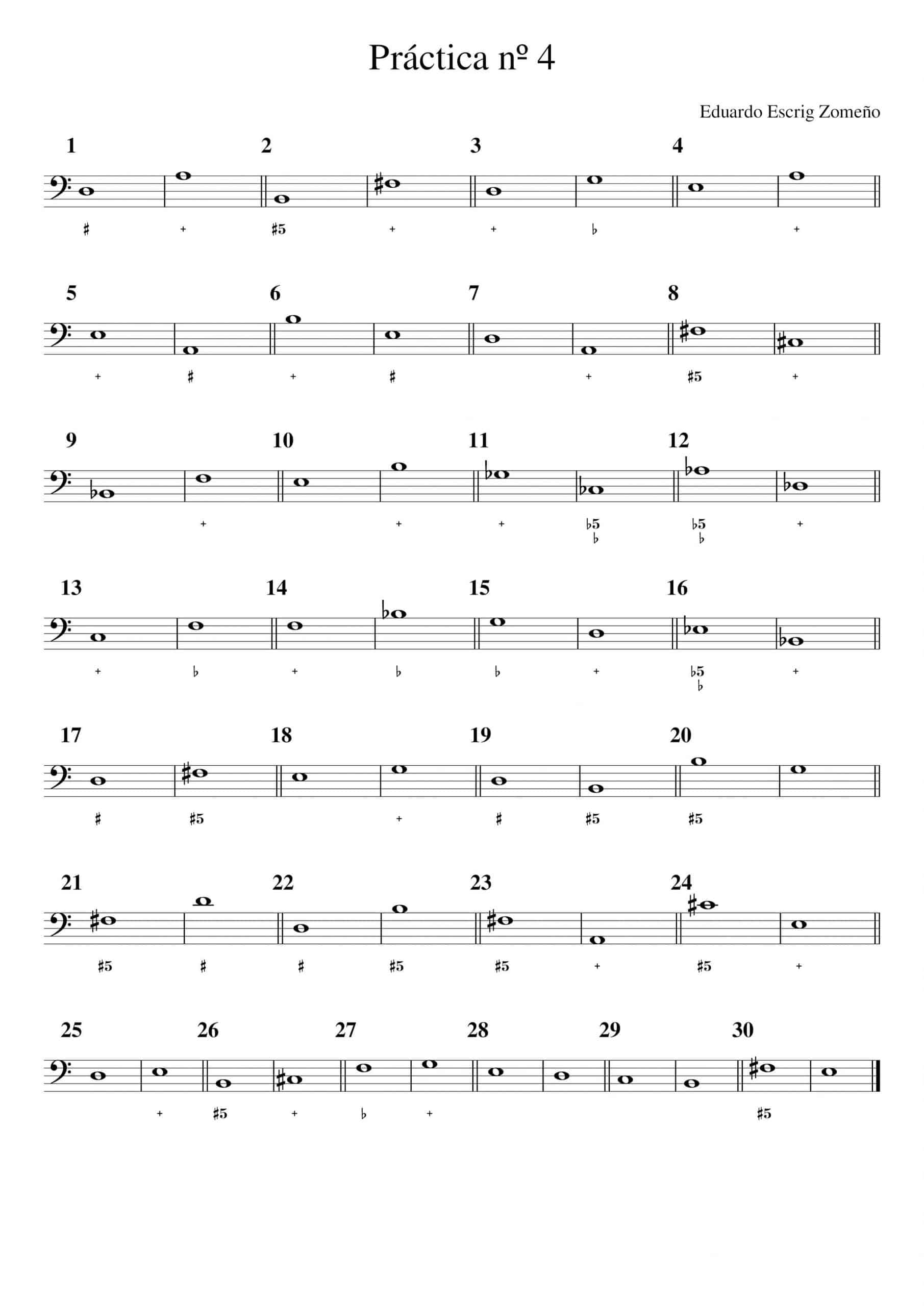
Connect the following chords keeping the common tone, and name the key in the cases where it can be determined. Each numbered pair is one connection; the sheet gives the bass line with its figures.
Reading the bass figures. This practice uses the Spanish conservatory system of figured bass. A sign alone under a bass note alters the third above it: + means the third is the leading tone (a major third, as in a dominant chord), ♯ raises the third and ♭ lowers it. A number with a sign alters that interval: ♯5 raises the fifth, and ♭5 together with ♭ gives a diminished triad. A bass note with no figure carries the plain chord of the key. The sheet shows only the bass and its figures; you write the three upper voices.
Audio
Proposed solution
Below is one possible solution. In harmony there is no single correct answer: other voicings that follow the rules are just as valid. The bass is shown in blue.
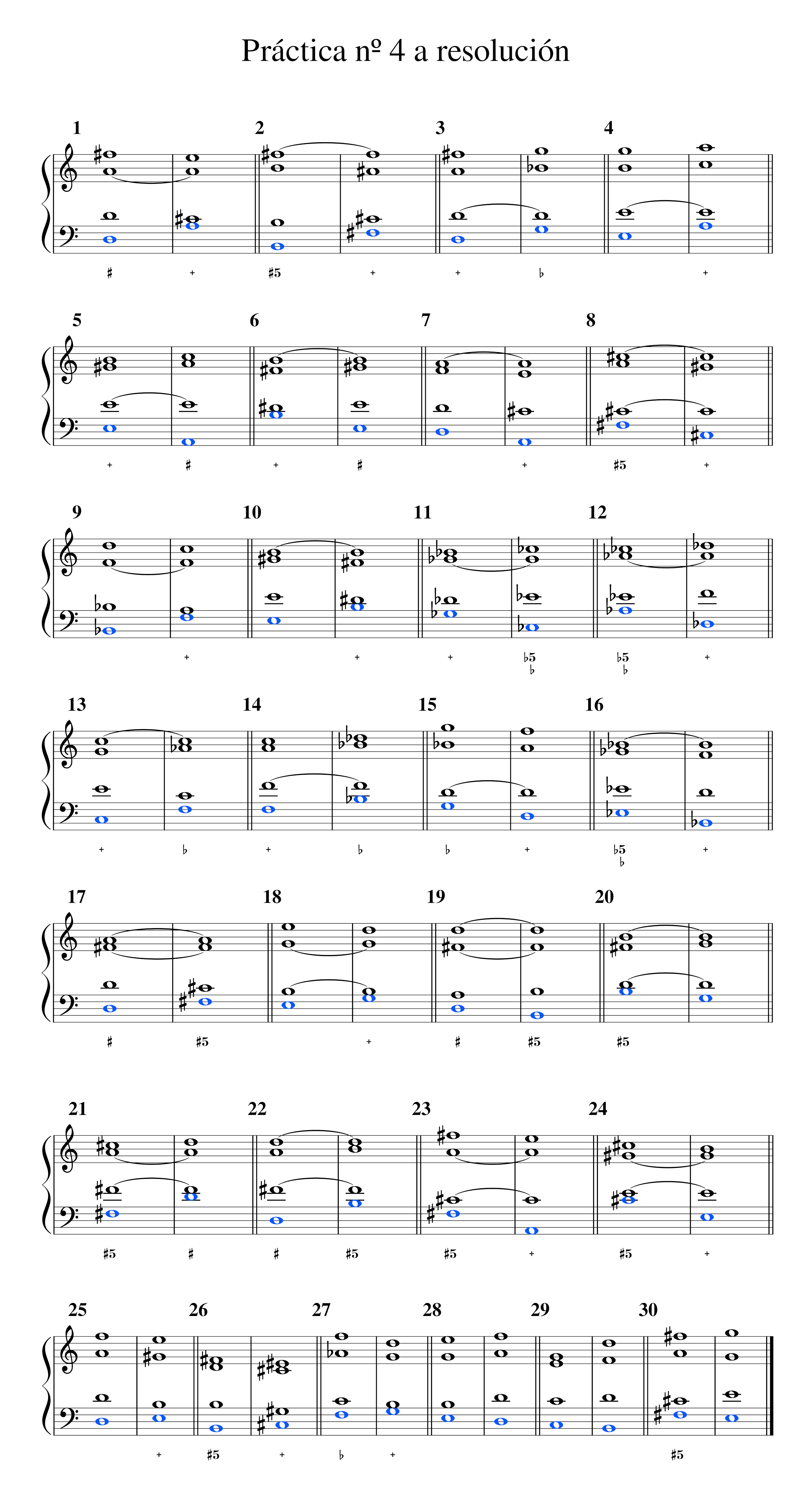
Which key does each connection belong to?
Keys
- D major
- B major or B minor
- G minor
- D major
- A major
- E major
- D minor
- F♯ minor
- B♭ major
- E minor
- C♭ major
- G♭ major
- F minor
- B♭ minor
- G minor
- E♭ minor
- D major, although it cannot be confirmed with certainty
- C major
- G major, although it cannot be confirmed with certainty
- G major, although it cannot be confirmed with certainty
- D major, although it cannot be confirmed with certainty
- G major, although it cannot be confirmed with certainty
- D major
- A major
- A minor
- F♯ minor
- C minor
- C major, although it cannot be confirmed with certainty
- C major, although it cannot be confirmed with certainty
- D major, although it cannot be confirmed with certainty
Where the answer says “although it cannot be confirmed with certainty”, the two chords fit that key but also other keys, so the key cannot be fixed from this pair alone.
Audio
Next exercise
To keep moving forward in your harmony studies, try the next exercise: Harmony exercise 4b.