We use our own cookies, which the site needs to work, and third-party cookies
for traffic analysis and advertising. You can accept them, reject the optional
ones, or choose which to allow.
Cookie policy.
NecessaryRequired for the site to work. They cannot be turned off.
AnalyticsMeasure traffic and browsing behavior (Google Analytics 4).
AdvertisingShow ads relevant to your interests (Google AdSense).
These are exercises in four-part harmony (soprano, alto, tenor and bass) in the style taught in Spanish conservatories. In a connection that keeps the common tone, any note that two consecutive chords share stays in the same voice, while the other voices move to the nearest chord tone. This gives smooth voice leading and avoids parallel fifths and octaves.
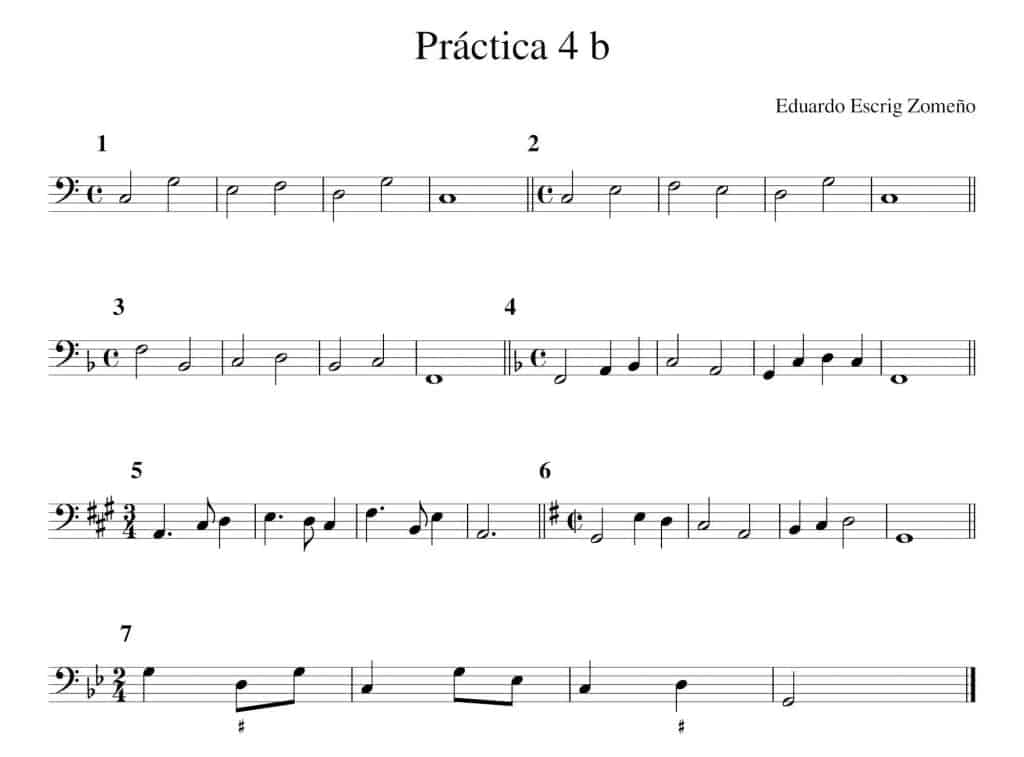
Harmonize the following bass lines, connecting the chords by keeping the common tone, and name the key wherever it can be determined. The bass lines are short phrases in different keys and meters; the key signature and meter are given on each staff.
Audio
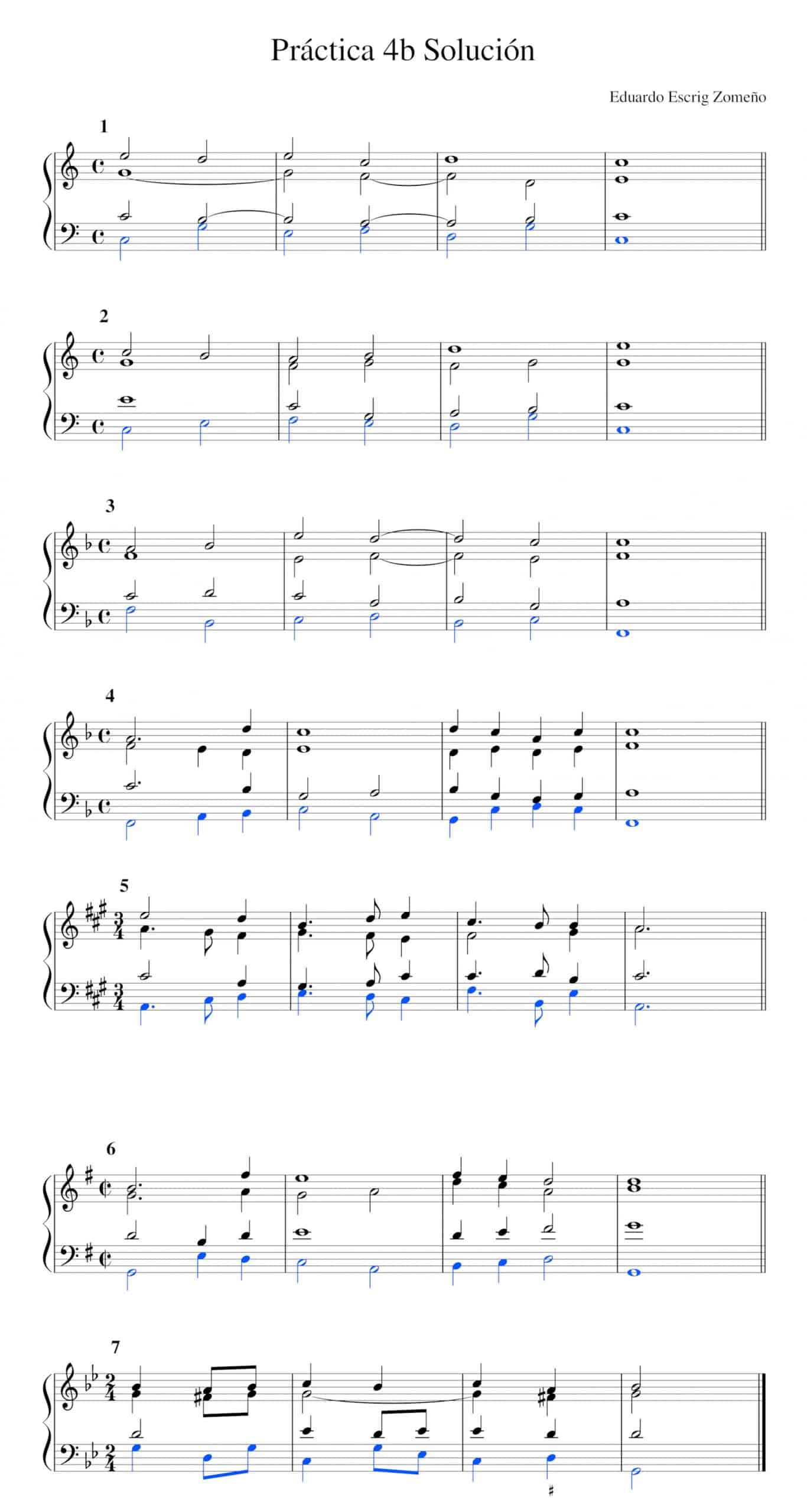
Proposed solution
Below is one possible solution. In harmony there is no single correct answer: other voicings that follow the rules are just as valid. The bass is shown in blue.
Audio
Next exercise
To keep moving forward in your harmony studies, try the next exercise: Harmony exercise 4c.
Frequently Asked Questions
What is a chord connection that keeps the common tone?
It means holding in the same voice the note (or notes) that two consecutive chords have in common, while the other voices move as little as possible.
Which voice should hold the common tone?
The voice that already has it in the first chord. If the soprano has G in the first chord and G also belongs to the second chord, the soprano holds that G.
When can you keep a common tone between two chords?
When the two chords share at least one note. In C major, I and IV share C, and I and V share G. Chords with nothing in common, such as IV and V, cannot be connected this way.
What does it mean to name the key of a connection?
It means finding the major or minor key in which both chords make sense, by working out the functions (tonic, subdominant, dominant) they could have there. A single pair of chords often fits more than one key.
What mistakes should you avoid?
Moving the common tone instead of holding it, writing parallel fifths or octaves in the other voices, not resolving the leading tone, and crossing voices without a reason.