
The dot is a small point written to the right of a note (or a rest). It lengthens the note by half of its value. It is one of the most common tools of rhythmic notation.
What is a dot and how is it calculated?
The rule is simple: the dot adds half of the note's own value. A dotted note therefore lasts its original value plus half of that value, which is one and a half times its length.
For example, a quarter note (UK: crotchet) is worth 1 beat. Half of that is half a beat (an eighth note, UK: quaver). So a dotted quarter note is worth 1 + ½ = 1.5 beats, the same as a quarter note tied to an eighth note.
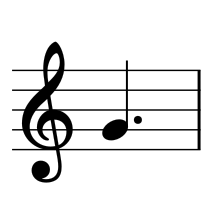
The value of each dotted note
Any note value can have a dot. Taking the quarter note as the beat, these are the durations of the seven dotted notes:
| Dotted note | Symbol | Value + half | Total duration |
|---|---|---|---|
| Dotted whole note | 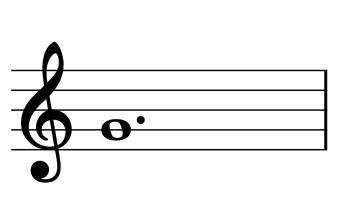 | 4 + 2 | 6 beats |
| Dotted half note | 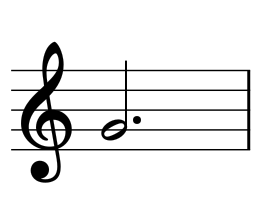 | 2 + 1 | 3 beats |
| Dotted quarter note | | 1 + ½ | 1½ beats |
| Dotted eighth note | 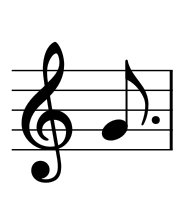 | ½ + ¼ | ¾ beat |
| Dotted sixteenth note | 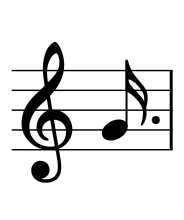 | ¼ + ⅛ | ⅜ beat |
| Dotted thirty-second note | 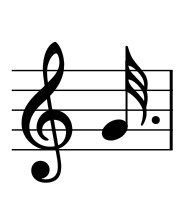 | ⅛ + 1/16 | 3/16 beat |
| Dotted sixty-fourth note | 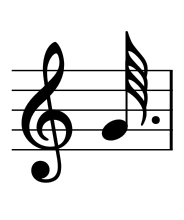 | 1/16 + 1/32 | 3/32 beat |
The dot on rests
The dot works in exactly the same way on rests: it lengthens the rest by half of its value. A dotted quarter rest is 1.5 beats of silence, just as a dotted quarter note is 1.5 beats of sound.
The double dot
The double dot is two dots in a row to the right of the note. The second dot adds half of the value of the first one, which is a quarter of the original note value. A double-dotted note therefore lasts its value plus a half plus a quarter (one and three quarters of its length).
For example, a double-dotted quarter note lasts 1 + ½ + ¼ = 1.75 beats, equal to a quarter note plus an eighth note plus a sixteenth note. The double dot is less common than the single dot, but it often appears in marches and in Baroque music.
The value of a dotted note depends on the time signature
The durations on this page take the quarter note as the beat, as in 2/4, 3/4 and 4/4. In compound meters (6/8, 9/8, 12/8) the beat is the dotted quarter note, so the counting changes: a dotted quarter note is worth 1.5 beats in 2/4 but 1 beat in 6/8. To practice, try the exercise on the value of notes in each time signature, with a PDF worksheet and answers.
Practice: the dot is a tie
One thing does not depend on the time signature: every dotted note sounds exactly the same as a pair of tied notes (with a double dot, three tied notes). A dotted quarter note and a quarter note tied to an eighth note are the same sound written two ways. Test this equivalence in both directions with the interactive exercise.