
The contrabassoon (UK also: double bassoon) is the lowest voice of the orchestral woodwinds: a tube of almost six meters (about 19 feet) folded back on itself several times that reaches down to a sounding B♭0, a half step (UK: semitone) above the lowest note of the piano. It is an octave transposer: it is written like the bassoon and sounds an octave below the written note. This page gives its notes, registers and how it differs from the bassoon.


| Family | Woodwind (double reed) |
|---|---|
| Pitch | C (octave transposer) |
| Transposition | Yes: sounds an octave below written |
| Range | Written B♭1–D5 (sounding B♭0–D4) |
| Mechanism | Keys |
| Clef | Bass (written like the bassoon) |
Does the contrabassoon transpose? The octave
Yes, and it is the only transposing member of the bassoon family. The bassoon sounds exactly what is written; the contrabassoon is written the same way (in bass clef, with the same note names) but sounds an octave lower. It is the simplest transposition possible: the bassoonist reads the same notes and the note name does not change, it just drops an octave. A written C4 sounds C3. All the notes below are written notes unless it says "sounding".
| Instrument | A written C4 sounds… |
|---|---|
| Bassoon | C4 (no transposition) |
| Contrabassoon | C3 (an octave lower) |
Range and registers
The standard written range runs from B♭1 to D5. In sounding pitch that is B♭0 (about 29 Hz) to D4. Some modern instruments have an extension to a written A1 (sounding A0, the lowest note of the piano). Like the bassoon, it changes clef to avoid ledger lines: bass clef in the low and middle registers, tenor clef (C clef on the fourth line) in the high register and treble clef in the very high register:
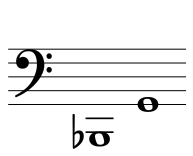
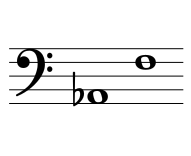
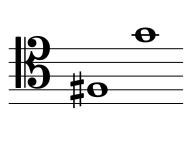
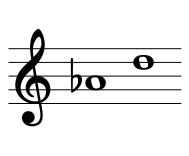
Pitches use scientific pitch notation (C4 is middle C). Counting the accidentals, it produces 41 different pitches in its standard range. Its natural territory is the low octave: doubling the basses, cellos and tuba and giving that dark floor you hear in the chest as much as in the ear. Ravel showed in Ma mère l'Oye that it can also sing.
Is the contrabassoon played like the bassoon?
Bassoonists play it and the hands sit the same way, but it is not simply a big bassoon. Its keywork and fingerings differ in places, and the folded tube has its own acoustics, so players use a fingering chart for their make of instrument. It also has a larger double reed than the bassoon, and it rests on the floor on an endpin, like a cello.
Choose a note and you will see its fingering, the note on the staff (in its real reading clef) and a real contrabassoon sound.
A little history and repertoire
The contrabassoon appeared in the Baroque as a low reinforcement for the bassoon; Handel asked for it in Music for the Royal Fireworks (1749). Beethoven brought it into the symphony, and the modern form of the instrument was established by the Heckel workshop in the late 19th century. Some places to hear it:
- Beethoven, Symphonies No. 5 and No. 9: its entry into the symphonic repertoire, in the finale of the Fifth and the "Turkish" march of the Ninth.
- Brahms, Symphony No. 1 and the Haydn Variations: the dark foundation of the chorale; Brahms treats it almost as the organ of the orchestra.
- Ravel, Ma mère l'Oye and the Piano Concerto for the Left Hand: the voice of the Beast, and the famous opening solo that rises out of the depths.
Common mistakes when learning contrabassoon notes
- Copying bassoon fingerings from memory. It works in places, but the contrabassoon does not follow the bassoon everywhere. Use a chart for the instrument.
- Forgetting the octave. What you read sounds an octave lower; the clef and note names are the bassoon's.
- Running out of air. Six meters of tube need huge columns of air; plan long phrases breath by breath.
- Relying on a tuner for the lowest notes. Many tuners do not read below about 40 Hz, so tune the bottom notes by ear against the same note an octave higher.
Summary
- The contrabassoon is an octave transposer: it is written like the bassoon and sounds an octave lower (written C4 sounds C3).
- Written range B♭1–D5 (sounding B♭0–D4, from about 29 Hz), about 41 pitches: the lowest voice of the orchestral woodwinds.
- It reads in bass, tenor and treble clef depending on the register, like the bassoon.
- Its fingerings are not simply the bassoon's: use a chart for your instrument.