
The bassoon is the bass of the double-reed family within the woodwinds. It is pitched in C and does not transpose: the written note is the sounding note. Its deep, warm and sometimes comic voice supports the whole woodwind section. Below you will find its range register by register, the clefs it reads and how its keywork (the German or Heckel system) is organized.


| Family | Woodwind (double reed) |
|---|---|
| Pitch | C |
| Transposition | None: it sounds as written |
| Range | B♭1–E♭5 (A1 with a long bell extension) |
| Mechanism | Keys (German or Heckel system) |
| Clefs | Bass, tenor (C clef on the fourth line) and sometimes treble |
Does the bassoon transpose? Which clef does it read?
No: the written note is the one that sounds. The bassoon usually reads in bass clef. When the music climbs into the upper register it is written in tenor clef (the C clef on the fourth line), and in the highest register sometimes in treble clef, to avoid a pile of ledger lines. Why three clefs? Because the range is more than three octaves. Written in bass clef alone, an E♭5 would need five ledger lines, which is almost unreadable. By changing clef, each register falls inside the staff (UK: stave). That is why bassoonists learn to read fluently in all three.
Range and registers
The standard range runs from the low B♭1 (the B♭ below the bass staff) to the very high E♭5: a little more than three octaves. Advanced players go above E♭5, and with the long bell extension the bottom note goes down to A1. This page divides the range into four registers:
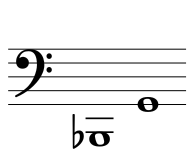
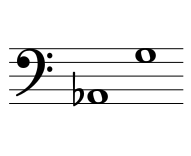
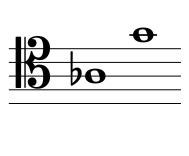
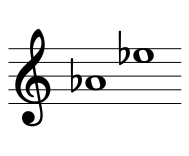
Octaves are in scientific pitch notation (C4 is middle C). Notice that the last two pictures are no longer in bass clef: the high register is shown in tenor clef and the very high register in treble clef, as they are written in practice.
| Register | Notes | Usual clef |
|---|---|---|
| Low | B♭1–G2 | Bass |
| Middle | A♭2–G3 | Bass |
| High | A♭3–G4 | Tenor |
| Very high | A♭4–E♭5 | Treble |
How many notes does the bassoon have?
As on every instrument there are only seven note names (C, D, E, F, G, A and B), but counting accidentals the bassoon produces 42 different pitches in its standard range, from B♭1 to E♭5. The same seven names repeat octave after octave over more than three octaves.
Compared with its woodwind neighbors, the bassoon is by far the lowest:
| Instrument | Range |
|---|---|
| Bassoon | B♭1–E♭5 (sounds as written) |
| Contrabassoon | Written from B♭1, sounds an octave lower (down to B♭0) |
| Bass clarinet | Written in treble clef, sounds a major 9th lower |
| B♭ clarinet | E3–A6 written (sounds a whole step lower) |
| English horn | B3–G6 written (sounds a perfect 5th lower) |
| Oboe | B♭3–G6 (sounds as written) |
| Flute | C4–C7 (sounds as written) |
| Piccolo | D4–C7 written (sounds an octave higher) |
How the sound is made: the double reed and the bocal
Like the oboe, the bassoon sounds with a double reed: two blades of cane tied together that vibrate against each other. The reed is not fitted straight onto the body but onto the bocal (also called the crook), the curved metal tube that connects it to the instrument. The bassoon's tube is about 2.5 meters (8 feet) long, so it is folded back on itself: the air goes down the wing joint to the boot, turns in a U and climbs back up the long joint to the bell, which points up above the player's head.
The German (Heckel) system and its keys
The bassoon is built in two main systems. The German or Heckel system is the standard almost everywhere; the French system (the basson) is now rare. The keywork has a feature that is unique among the woodwinds: the thumbs do a great deal of work. The left thumb alone operates nine or more keys: the whisper key (near the bocal), the high A, C and D keys used in the upper register, several low keys (D, C, B and B♭) and the C♯ key. The right thumb has keys such as the low B♭ key, the big low E key (the "pancake"), an F♯ key and a G♯ key.
Bassoon fingerings
Each note comes from a combination of tone holes and keys. There are six main tone holes (1–3 for the left hand, 4–6 for the right), the thumb keys between the two joints and the little-finger keys at the bottom. For several notes the left index finger covers its hole only halfway (a "half hole").
Choose a note and you will see its fingering, the written note in its real clef (bass, tenor or treble, depending on the register) and a real bassoon sound.
The contrabassoon: the bassoon's low relative
The contrabassoon is the lowest voice of the orchestral woodwinds: the same double-reed principle, but a tube twice as long as the bassoon's. Unlike the bassoon it is an octave transposing instrument: it is written in bass clef like the bassoon and sounds an octave lower than written, down to B♭0, just a half step above the lowest note of the piano. It has its own guide: contrabassoon notes.
Common mistakes when learning bassoon notes
- Forgetting the half hole. Several notes in the middle and upper register ask you to uncover only half of the first hole of the left hand. If it stays fully covered, the note will not speak or it drops an octave.
- Not using the thumb keys in the high register. The high A, C and D keys help the upper notes to start cleanly; without them the note tends to crack or gurgle.
- Neglecting the whisper key. In much of the low and middle register it must be held down: it steadies the low notes and stops the note from jumping to a harmonic. Check a fingering chart for exactly which notes.
- Getting lost between clefs. A rising passage leaves the bass clef and reappears in tenor clef. It is worth practicing reading both from the start.
In short
- The bassoon is pitched in C and does not transpose; it reads in bass clef, tenor clef and sometimes treble clef.
- Its standard range runs from B♭1 to E♭5 (four registers), about 42 pitches.
- The sound comes from a double reed on the bocal; the 2.5 m tube is folded in a U.
- It uses the German (Heckel) system: the left thumb handles nine or more keys.