
The flute (the concert or transverse flute) is a woodwind held sideways. It sounds when the player blows across the hole of the embouchure (it has no reed). Its music is read in treble clef and uses the same seven note names as always: C, D, E, F, G, A, B. What is special about the flute is how each note is produced: with a fingering of the Boehm system.


| Family | Woodwind (edge-blown, no reed) |
|---|---|
| Pitch | C |
| Transposition | None: it sounds as written |
| Range | C4–C7 (B3 with a B foot joint) |
| Mechanism | Keys (Boehm system) |
| Clef | Treble |
Does the flute transpose?
No. The concert flute is pitched in C and sounds as written: if you read a C, a C sounds. This sets it apart from other members of its family that do transpose, such as the piccolo (it sounds an octave higher than written, with the same fingerings as the flute), the alto flute in G (it sounds a perfect 4th lower than written) and the bass flute (an octave lower). So for the concert flute there is nothing to "transpose": what you see on the score is what you hear.
Range and registers
The usual range of the flute covers three octaves, from C4 to C7. With the B foot joint (an optional extension) it reaches B3, and advanced players go above C7 in the repertoire. These three octaves are divided into four registers:
| Register | Range | On the staff | Character |
|---|---|---|---|
| Low | C4 – C5 | 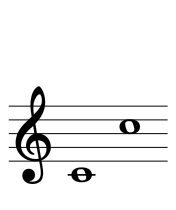 | Warm and velvety; it does not project much. |
| Middle | C5 – C6 | 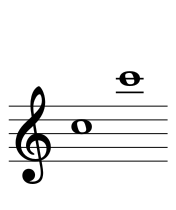 | The most balanced and comfortable. |
| High | C6 – C7 | 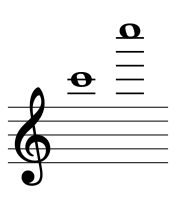 | Bright and piercing. |
| Very high | above C7 | 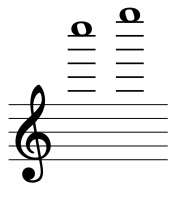 | Difficult; it demands a lot of control of air and embouchure. |
Remember that octave numbers depend on the system. This page uses international scientific pitch notation (middle C = C4). Some Spanish and French sources use the Franco-Belgian system, where middle C is C3, so the same range is written C3 to C6.
How many notes does the flute have?
There are only seven note names (C, D, E, F, G, A and B), but the flute produces many more sounds, because those names repeat in every octave. Counting all the notes, natural and with accidentals, from C4 to C7, the flute gives 37 different pitches across its three octaves. The lowest is C4 (or B3 with a B foot joint) and the highest is C7.
How the sound is produced
Unlike the clarinet or the oboe, the flute has no reed: the sound starts when the air is directed against the edge of the embouchure hole, like blowing across the neck of a bottle. One detail matters for understanding fingerings: many notes of the low and middle registers share the same fingering and differ by overblowing (changing the air speed and the embouchure makes the note jump up an octave). So one finger position can give two notes an octave apart.
The Boehm system
Most modern flutes use the Boehm system: a key mechanism that lets you play every note with a logical fingering and much steadier tuning than older models. It was devised by the German flutist and inventor Theobald Boehm in the mid-19th century, who placed each tone hole in its acoustically best position and used keys and rings so that the fingers could reach them. That is why almost all flutes today share the same fingering.
Flute fingerings
Each note comes from a specific combination of keys pressed. Learning the flute is, to a large extent, making those fingerings automatic, register by register. As we saw, the same fingering often serves for a low note and the note an octave above it thanks to overblowing, which reduces what you have to memorize.
The keys are arranged like this. The left hand uses the index, middle and ring fingers, plus the G♯ lever with the little finger and two thumb keys (B and B♭). Between the two hands are the two trill keys. The right hand uses the index, middle and ring fingers, and the little finger works the E♭ key and the two foot joint keys, C♯ and C.
Choose a note and you will see which keys are pressed on the flute:
You can tune your notes with our flute tuner, and if you are starting to read treble clef, practice with the note reading exercises.
Common mistakes when learning flute notes
- Thinking every note has its own fingering. Many share the same finger position and only change by overblowing (the octave). Understanding this cuts down a lot of what you have to memorize.
- Blowing harder to go higher. High notes do not come from more force, but from faster, more focused air and a smaller lip opening.
- Confusing the little-finger keys. The foot keys (C, C♯) and the E♭ key are easy to mix up at first; look carefully at the chart.
- Neglecting the embouchure. Without a steady angle and lip opening, intonation and tone suffer more than from the fingers.
Summary
- The flute is pitched in C and does not transpose.
- Its range covers about three octaves (C4–C7): 7 note names and 37 pitches.
- It uses the Boehm key system.
- Each note has a specific fingering, and many are shared between octaves thanks to overblowing.