
There are seven musical notes. In English-speaking countries they are named with the letters C, D, E, F, G, A and B. In Spanish-, French- and Italian-speaking countries they are named with the fixed-do solfège syllables Do, Re, Mi, Fa, Sol, La and Si. In the German system the natural B is written H, and the German B is B♭.
- English (letters): C · D · E · F · G · A · B
- Fixed-do (Spanish, French, Italian): Do · Re · Mi · Fa · Sol · La · Si (French writes Ré)
- German: C · D · E · F · G · A · H (B♮ is H and B♭ is B)
"Fixed do" means that Do is always the note C, whatever the key. (Some countries use "movable do", where Do is the tonic of the key; that is a different system.) This site uses letters as the main names and gives the fixed-do names where they help.
The syllables come from a medieval hymn to St. John, whose lines began on the syllables Ut, Re, Mi, Fa, Sol, La. Guido d'Arezzo used them in the 11th century to teach singers. Over time Ut became Do and Si was added.
Equivalence table: letters, fixed-do and German
The letters A–G are the standard in English-speaking countries and are also used to name instruments' transpositions (for example, "clarinet in B♭"). German adds one peculiarity: the letter B means B♭ and the letter H means B natural.
| English | Fixed-do | German |
|---|---|---|
| C | Do | C |
| D | Re | D |
| E | Mi | E |
| F | Fa | F |
| G | Sol | G |
| A | La | A |
| B | Si | H |
| B♭ | Si♭ | B |
Fun fact: this German peculiarity allowed Johann Sebastian Bach to sign his music with the notes B♭–A–C–B♮, which are spelled B–A–C–H in German. This "BACH motif" appears, among other works, in the unfinished fugue of his Art of Fugue, and later composers such as Liszt, Schumann and Schoenberg used it as a tribute.
Registers: notes repeat in every octave
The 7 note names repeat across the whole range of sound. To say which register a note is in, we add an octave number: C4 is middle C (the middle key of the piano), C5 is an octave higher and C3 an octave lower. The higher the number, the higher the sound. There are two ways to number octaves: the international system (scientific pitch notation), in which middle C is C4, and the French-Belgian system, in which it is C3. See the page on octave numbering. A4 = 440 Hz in the international system.
| Register | Approximate range | Examples |
|---|---|---|
| Very low (sub-bass) | C0 – B1 | Contrabassoon, lowest notes of tuba and double bass |
| Low | C2 – B2 | Cello, bass voice |
| Medium-low | C3 – B3 | Viola, baritone voice |
| Middle | C4 – B4 | Middle C and the octave above it |
| High | C5 – B5 | Flute, soprano voice, violin |
| Very high | C6 – B7 | Piccolo, highest notes of the piano |
The 12 notes with accidentals
Each of the 7 natural notes can be raised by a half step (UK: semitone) with a ♯ (sharp) or lowered by a half step with a ♭ (flat). This gives 12 different notes within an octave, which form the chromatic scale:
C – C♯/D♭ – D – D♯/E♭ – E – F – F♯/G♭ – G – G♯/A♭ – A – A♯/B♭ – B – C
Notes joined by a slash (such as C♯ and D♭) sound the same on the piano but are named differently depending on the harmonic context. They are called enharmonic notes. Between E and F, and between B and C, there is no note in between: they are already natural half steps.
Accidentals in fixed-do and German
In English the words sharp (♯) and flat (♭) follow the letter. In fixed-do Spanish and French the syllable is followed by "sharp" or "flat" in the local language (Do♯, Si♭). German has its own rules: sharps end in -is and flats end in -es. The exception to remember is B♭, which in German is simply B (and B natural, remember, is H).
| English | Fixed-do | German |
|---|---|---|
| C♯ (C sharp) | Do♯ | Cis |
| D♭ (D flat) | Re♭ | Des |
| D♯ | Re♯ | Dis |
| E♭ | Mi♭ | Es |
| F♯ | Fa♯ | Fis |
| G♭ | Sol♭ | Ges |
| G♯ | Sol♯ | Gis |
| A♭ | La♭ | As |
| A♯ | La♯ | Ais |
| B♭ | Si♭ | B |
The same rule forms the less common accidentals: E♯ is Eis, B♯ is His, C♭ is Ces and F♭ is Fes.
Where are the notes placed in the different clefs?
There are 7 clefs in common use (treble, F clef on the 3rd and 4th lines, and C clef on the 1st, 2nd, 3rd and 4th lines). Each clef defines which note sits on its reference line of the staff, and that sets the position of all the others.
Treble clef
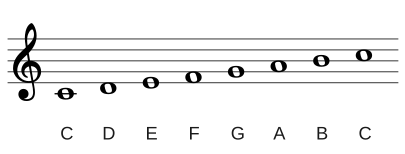
In the treble clef, G4 is on the 2nd line. The lines of the staff (from the bottom up) are E–G–B–D–F and the spaces are F–A–C–E. The 1st ledger line below the staff is C4 (middle C).
Bass clef (F clef on the 4th line)
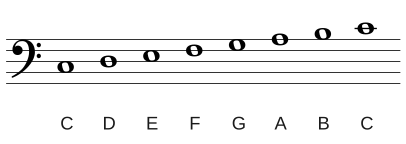
In the bass clef, F3 is on the 4th line. The lines (from the bottom up) are G–B–D–F–A and the spaces are A–C–E–G. Middle C appears on the 1st ledger line above the staff.
F clef on the 3rd line
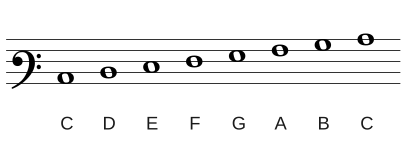
In the F clef on the 3rd line (baritone clef), F is on the 3rd line. The lines (from the bottom up) are B–D–F–A–C. It is rare in current music and appears in some older baritone vocal and cello scores.
C clef on the 1st line
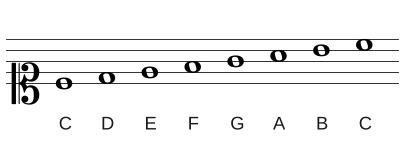
In the C clef on the 1st line (soprano clef), C4 is on the 1st line. The lines (from the bottom up) are C–E–G–B–D. It was used for soprano voices in Renaissance and Baroque vocal music.
C clef on the 2nd line
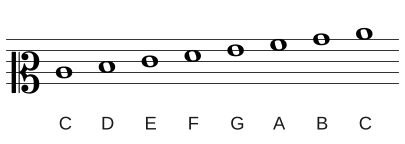
In the C clef on the 2nd line (mezzo-soprano clef), C4 is on the 2nd line. The lines (from the bottom up) are A–C–E–G–B. It is rare in modern music and was used for mezzo-soprano voices in older vocal music.
C clef on the 3rd line
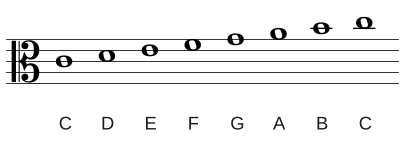
In the C clef on the 3rd line (alto clef), C4 is on the 3rd line. It is the standard clef of the viola and is also used in some alto trombone passages. The lines (from the bottom up) are F–A–C–E–G.
C clef on the 4th line
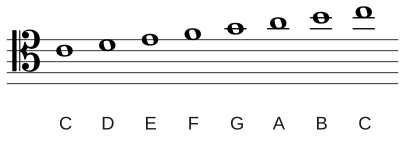
In the C clef on the 4th line (tenor clef), C4 is on the 4th line. It is used by the bassoon, the tenor trombone and the cello in high-register passages. The lines (from the bottom up) are D–F–A–C–E and the spaces are E–G–B–D.