
The half step (UK: semitone) is the smallest distance between two notes in Western equal temperament, equal to moving one key on the piano. The whole step (UK: tone) is two half steps joined together. These two ideas are the basis for building scales, intervals and chords in Western music.
- Half step: the smallest distance between two notes; on the piano, moving to the next key (white or black).
- Whole step: the sum of two consecutive half steps; on the piano, a distance of two keys with one key in between.
| Half step | The smallest distance (neighboring keys on the piano). |
| Whole step | Two half steps in a row. |
| Major scale pattern | Whole · Whole · Half · Whole · Whole · Whole · Half |
| One octave | 12 half steps = 6 whole steps (the 12 notes of the chromatic scale) |
| The complete major scale | 5 whole steps and 2 half steps (5 × 2 + 2 = 12 half steps) |
Whole steps and half steps in the C major scale
The C major scale is the clearest example for understanding whole steps and half steps: it has no accidentals, so the distances can be seen directly on the natural notes.

| Scale degrees | Notes | Distance |
|---|---|---|
| 1 → 2 | C → D | Whole step |
| 2 → 3 | D → E | Whole step |
| 3 → 4 | E → F | Half step |
| 4 → 5 | F → G | Whole step |
| 5 → 6 | G → A | Whole step |
| 6 → 7 | A → B | Whole step |
| 7 → 8 | B → C | Half step |
The resulting pattern is W–W–H–W–W–W–H (W = whole step, H = half step). The two natural half steps of the major scale always fall between degrees 3–4 (E–F in C major) and 7–8 (B–C in C major).
Measure it yourself: the keyboard
On a keyboard, the whole step C–D skips over one black key, and the natural half steps (E–F and B–C) are neighboring white keys with no black key between them. Check it: press one key and then another and the page counts the steps between the two (each key, white or black, is one step) and converts them into whole steps and half steps. You can also try the example buttons.
Half step
The half step is the smallest possible distance between two notes in Western equal temperament. On the piano it means moving from one key to the nearest adjacent key, white or black. There are two pairs of white keys with no black key between them: E–F and B–C. That is where the natural half steps are.
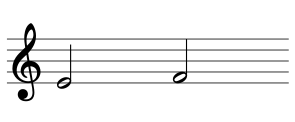
There are two kinds of half step that sound the same but are written differently:
- Diatonic half step: between notes with different letter names (E–F, B–C, C–D♭).
- Chromatic half step: between notes with the same letter name, one natural and one altered (C–C♯, F–F♯).
See the page on diatonic and chromatic half steps for a closer look.
Whole step
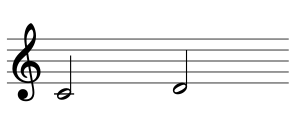
A whole step equals exactly two half steps. On the piano it means moving from one key to the next key of the same color, two steps along the chromatic keyboard. Some examples:
- C → D: C♯/D♭ lies between them. Result: 1 whole step (2 half steps).
- D → E: D♯/E♭ lies between them. Result: 1 whole step.
- F → G: F♯/G♭ lies between them. Result: 1 whole step.
The same pattern in every major scale
The pattern W–W–H–W–W–W–H is the "signature" of the major scale, and it applies the same way in every key. It is the accidentals in the key signature that keep the distances the same:
| Scale | Notes | 1→2 | 2→3 | 3→4 | 4→5 | 5→6 | 6→7 | 7→8 |
|---|---|---|---|---|---|---|---|---|
| C major | C D E F G A B C | W | W | H | W | W | W | H |
| G major | G A B C D E F♯ G | W | W | H | W | W | W | H |
| F major | F G A B♭ C D E F | W | W | H | W | W | W | H |
| D major | D E F♯ G A B C♯ D | W | W | H | W | W | W | H |
The notes of each scale are on the page for natural major scales.
Whole steps and half steps in the natural minor scale
The natural minor scale has a different pattern: W–H–W–W–H–W–W. Its half steps fall between degrees 2–3 and 5–6, which gives it its characteristic sound compared with the major scale.
| Scale degrees | Notes (A minor) | Distance |
|---|---|---|
| 1 → 2 | A → B | Whole step |
| 2 → 3 | B → C | Half step |
| 3 → 4 | C → D | Whole step |
| 4 → 5 | D → E | Whole step |
| 5 → 6 | E → F | Half step |
| 6 → 7 | F → G | Whole step |
| 7 → 8 | G → A | Whole step |
See the page on natural minor scales for this pattern in all the minor keys.
The chromatic scale: 12 half steps in an octave
Chaining all the possible half steps one after another gives the chromatic scale. It contains the 12 notes of Western equal temperament and spans exactly one octave:
C – C♯ – D – D♯ – E – F – F♯ – G – G♯ – A – A♯ – B – C
An octave equals 12 half steps or, in other words, 6 whole steps.
Whole steps, half steps and intervals
The number of half steps is the most precise way to measure the size of a musical interval. Each interval corresponds to a fixed number of half steps:
| Half steps | Equivalent in whole steps | Interval |
|---|---|---|
| 1 | ½ step | minor 2nd |
| 2 | 1 whole step | Major 2nd |
| 3 | 1½ steps | minor 3rd |
| 4 | 2 whole steps | Major 3rd |
| 5 | 2½ steps | Perfect 4th |
| 6 | 3 whole steps | Tritone (Augmented 4th / Diminished 5th) |
| 7 | 3½ steps | Perfect 5th |
| 8 | 4 whole steps | minor 6th |
| 9 | 4½ steps | Major 6th |
| 10 | 5 whole steps | minor 7th |
| 11 | 5½ steps | Major 7th |
| 12 | 6 whole steps | Perfect octave |
Altered notes
Accidentals (♯ and ♭) change the pitch of a note by a half step, and they directly affect the distance between notes:
- If the upper note is raised with ♯, the distance grows by a half step.
- If the upper note is lowered with ♭, the distance shrinks by a half step.
- If the lower note is raised with ♯, the distance shrinks; if it is lowered with ♭, the distance grows.
Specific examples:
- E–F♯: E–F is a half step; raising F to F♯ adds a half step → whole step.
- C–D♭: C–D is a whole step; lowering D to D♭ takes away a half step → half step.
- C♯–D: C–D is a whole step; raising C to C♯ makes the distance shorter → half step.
- E♭–F: E–F is a half step; lowering E to E♭ makes the distance larger → whole step.
How to tell whether there is a whole step or a half step between two notes
- Find the two notes on a keyboard (or picture their positions).
- Count the smallest steps between them, counting both white and black keys.
- One step = half step; two steps = whole step.
The key is the two pairs of white notes that are already a half step apart: E–F and B–C (there is no black key between them). Between every other pair of neighboring white notes there is a whole step.
What are whole steps and half steps for?
They are the unit of measurement of all Western music. They are used to:
- Build scales: every scale is a fixed pattern of whole steps and half steps.
- Calculate intervals and form chords.
- Transpose a melody to another key without changing its shape.
- Understand harmony: why there are tensions and points of rest.
Common mistakes
- Believing there is a whole step between all white notes: between E–F and B–C there is a half step.
- Thinking a half step always involves a black key: E–F and B–C are half steps between white keys.
- Forgetting that accidentals change the distance: E–F is a half step, but E–F♯ is a whole step.