
A diatonic half step (UK: diatonic semitone) is formed between two notes with different letter names, such as E–F or B–C. A chromatic half step is formed between two notes with the same letter name and a different accidental, such as C–C♯. Both measure exactly the same, one half step, but they are written and they work differently. This distinction is one of the keys to music notation and to the study of whole steps and half steps: the diatonic half step is written as a minor 2nd and the chromatic half step as an augmented unison.
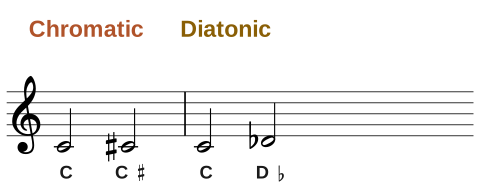
| Type | Notes | Examples | Written interval |
|---|---|---|---|
| Diatonic | Different letter names | E–F, B–C, A♯–B, D♯–E | minor 2nd |
| Chromatic | Same letter name | C–C♯, G♯–G, B–B♯, E–E♭ | Augmented unison |
In equal temperament both types measure exactly the same (100 cents, one half step). The difference lies only in spelling and in harmonic function.
What is a diatonic half step?
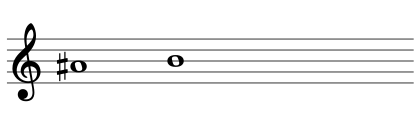
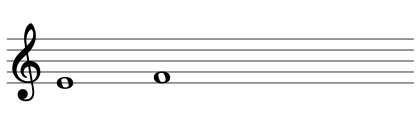
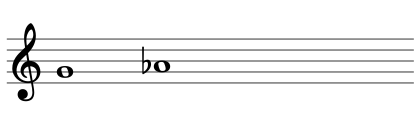
A diatonic half step is one in which the letter names of the two notes are different, for example E–F, B–C or A♯–B, always keeping the distance of one half step. Because it uses two different letter names, it is written as a minor 2nd, and it is the half step that occurs naturally within scales.
The staves below show several examples of diatonic half steps.
What is a chromatic half step?
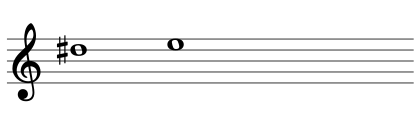
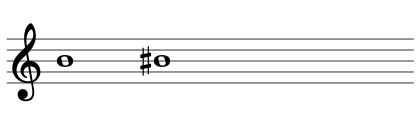
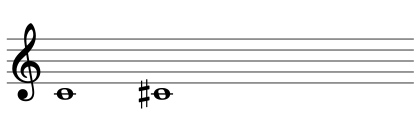
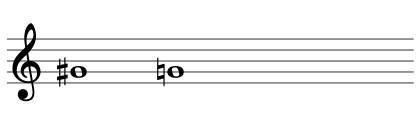
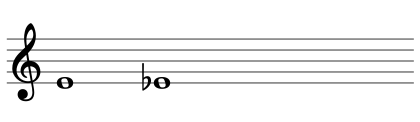
A chromatic half step is one in which the two note names are the same, with a different accidental, always keeping the distance of one half step.
The staves below show several examples of chromatic half steps.
How to tell the two types apart
The rule is simple: look at the letter names.
- If the two notes have different letter names (C and D♭, E and F, A♯ and B) → diatonic. It is written as a minor 2nd.
- If the two notes have the same letter name (C and C♯, G and G♭) → chromatic. It is written as an augmented unison.
In scales and most melodies, the half steps between consecutive scale degrees are diatonic: the notes always have different letter names. Chromatic half steps appear when a note is altered in passing, as in a chromatic passage, where the direction of the line usually decides the spelling (C–C♯ going up, D–D♭ going down). Writing C–C♯ where the key and the context call for C–D♭ is a spelling error, even though the notes sound the same on the piano.
Where diatonic half steps appear in scales
| Scale | Diatonic half steps | Between scale degrees |
|---|---|---|
| C major | E–F, B–C | 3–4 and 7–8 |
| A natural minor | B–C, E–F | 2–3 and 5–6 |
| A harmonic minor | B–C, E–F, G♯–A | 2–3, 5–6 and 7–8 |
| A melodic minor (ascending) | B–C, G♯–A | 2–3 and 7–8 |
In all these cases, the half steps within the scale are diatonic: between notes with different letter names.
The chromatic half step is closely related to the idea of enharmonic notes: C and C♯ share a letter name, but C♯ sounds the same as D♭, which has a different letter name.