
The unison is the zero distance between two notes that have the same name and sound exactly alike. Enharmonic notes sound the same but have different names, such as C sharp and D flat. Both ideas are basic to music writing and to the theory of intervals.
Unison
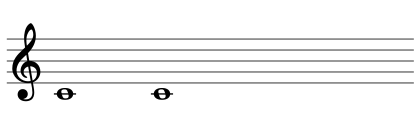
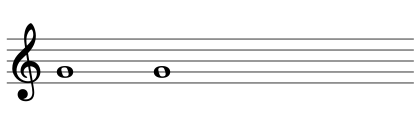
A unison happens when two voices or instruments play the same note at the same time. As a distance it is zero half steps: the notes neither rise nor fall. It is written as a perfect unison (perfect 1st) in the classification of intervals. In counterpoint it needs no preparation or resolution, and it is the most complete consonance possible.
Examples on the staff:
Enharmonic notes
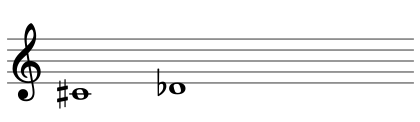
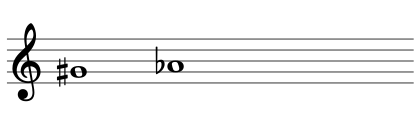
Enharmonic notes sound the same but are written with different names. This happens because the notation system uses only 7 note names, and when they are altered with sharps or flats, some notes with different names land on the same pitch.
Full chart of enharmonic equivalents
All the notes that can have an alternative name in equal temperament:
| Note | Enharmonic equivalent | Most common use |
|---|---|---|
| C♯ | D♭ | C♯ in keys with sharps; D♭ in keys with flats |
| D♯ | E♭ | D♯ is uncommon; E♭ is usual in B♭, E♭ and A♭ major |
| E | F♭ | F♭ appears only in keys with 7 flats (C♭ major, A♭ minor) |
| F | E♯ | E♯ appears only in keys with 6 or 7 sharps (F♯ major, C♯ major, D♯ minor, A♯ minor) |
| F♯ | G♭ | F♯ in keys with sharps; G♭ in keys with flats |
| G♯ | A♭ | G♯ in keys with sharps; A♭ in keys with flats |
| A♯ | B♭ | A♯ is uncommon; B♭ is usual in F, B♭, E♭… major |
| B | C♭ | C♭ appears only in keys with 6 or 7 flats (G♭ major, C♭ major, E♭ minor, A♭ minor) |
| C | B♯ | B♯ appears only in keys with 7 sharps (C♯ major, A♯ minor) |
The five most frequent pairs are: C♯ = D♭, D♯ = E♭, F♯ = G♭, G♯ = A♭ and A♯ = B♭. The pairs involving E♯/F♭ and B♯/C♭ appear only in keys with many accidentals (6 or 7).
Enharmonic keys
Enharmony also applies to whole keys. There are three pairs of major keys that sound the same but are written with different names and key signatures:
| Key (with sharps) | Enharmonic key (with flats) |
|---|---|
| F♯ major (6♯) | G♭ major (6♭) |
| B major (5♯) | C♭ major (7♭) |
| C♯ major (7♯) | D♭ major (5♭) |
A player who plays in F♯ major and one who plays in G♭ major make exactly the same sound, but the composer chooses one spelling or the other according to the direction of the music or how easy it is to read for each instrument.
Why does the name of the note matter?
In tonal harmony, a note's name is not just a label: it shows its function and its tendency to move:
- C♯ in D major is the leading tone (UK: leading note): it tends to rise to D.
- D♭ in A♭ major is the subdominant (4th degree): it tends to fall to C.
Although they sound the same on the piano, a good musician hears them with different expectations. Enharmony is also the gateway to enharmonic modulations: a pivot note is reinterpreted as another to jump between distant keys, a device widely used in Romantic music.
To understand the difference between diatonic and chromatic half steps, which is closely tied to enharmony, see diatonic and chromatic half steps.