
What are clefs?
The clef is the first sign on every staff. Its job is vital: it is the reference point that gives each note a name and a specific pitch. Without it, the five lines of the staff would have no meaning.
There are 3 types of clef (G, F and C) which, depending on the line of the staff they sit on, give 7 clefs in total:
- Treble clef (G clef) on the 2nd line — 1 position.
- Bass clef (F clef) on the 3rd and 4th lines — 2 positions.
- C clef on the 1st, 2nd, 3rd and 4th lines — 4 positions.
1. Treble clef (G clef on the 2nd line)
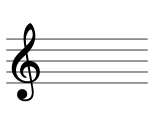
It is the most used clef in Western music. It says that the note G4 (the G above middle C) sits on the 2nd line. From there, the other notes are named going up and down. It is used by the guitar, violin, flute, the right hand of the piano and high voices. → Complete guide to the treble clef.
2. Bass clef (F clef on the 4th and 3rd lines)
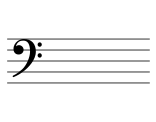
It is used for low sounds. The most common is the F clef on the 4th line, the standard for electric bass, cello, bassoon and the left hand of the piano. → Complete guide to the bass clef.
3. C clef (on the 1st, 2nd, 3rd and 4th lines)
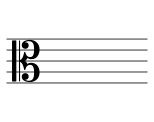
It is less common in popular music but essential in the orchestra and the conservatory. The C clef on the 3rd line (alto clef) is the standard for the viola, while the C clef on the 4th line (tenor clef) is used for instruments such as the trombone. The center of the sign always marks where middle C is. → Complete guide to the C clef.
Comparison chart of the clefs
| Clef | Reference note | Main use |
|---|---|---|
| G on the 2nd line | G4 (2nd line) | High registers (guitar, soprano voice) |
| F on the 4th line | F3 (4th line) | Low registers (bass, tuba) |
| C on the 3rd / 4th line | C4 (3rd or 4th line) | Middle registers (viola, trombone) |
The three clefs, one by one
Each clef has its own complete guide, with all its notes line by line, its memory trick and its reading exercise. Here is just enough to know which one you need:
Treble clef (G clef on the 2nd line)
It puts G4 on the 2nd line. It is the most used of all and nearly always the first one learned: it is read by violin, guitar, flute, clarinet, saxophone, trumpet, the right hand of the piano and high voices. If you play a wind instrument in a band, it is almost certainly your clef. Complete guide to the treble clef →
Bass clef (F clef on the 4th line)
It puts F3 on the 4th line. It is the clef of the low register: cello, double bass, bassoon, tuba, euphonium, electric bass and the left hand of the piano. Complete guide to the bass clef →
C clef (on the 3rd line and its other positions)
It puts C4, middle C, on whichever line it is placed, which is why it is the only clef used in several positions. The 3rd-line clef is the viola's; the 4th-line clef appears in the high register of the bassoon, trombone and cello. The 1st- and 2nd-line clefs are tied to historical voice types. Complete guide to the C clef and its 4 positions →
Practice with the three clefs mixed
Reading one clef alone is half the job; the hard part is switching clefs without losing your place. Practice with the exercises, one clef at a time:
Equivalence between clefs
All clefs represent the same sounds; the only thing that changes is where each pitch is placed on the staff. The common reference point is middle C: the same note is written in a different position in each clef. That is why, when you change clef, a note “moves up” or “moves down” a line even though it sounds exactly the same. To say which octave each note belongs to (for example C3 or C4), octave numbers are used.

Follow the path of middle C: it starts below the staff in the treble clef and moves up one step with each clef until it ends above the staff in the F clef on the 4th line:
| Clef | Position of middle C |
|---|---|
| G on the 2nd line | 1st ledger line below |
| C on the 1st line | 1st line |
| C on the 2nd line | 2nd line |
| C on the 3rd line | 3rd line |
| C on the 4th line | 4th line |
| F on the 3rd line | 5th line |
| F on the 4th line | 1st ledger line above |
Why are there so many clefs?
The reason is purely practical: reading economy. Writing the notes of a bass in the treble clef would need too many ledger lines, making reading slow and confusing. By changing clef, the instrument's register is centered on the staff and reading is smoother.
It is best to master the treble clef and the bass clef on the 4th line first; between them they cover most of the music you will meet.
To master the positions of notes on the staff, see also note names. (In Spanish-, French- and Italian-speaking countries, the clefs are named with the fixed-do names: clave de Sol for the G clef, clave de Fa for the F clef and clave de Do for the C clef.)