
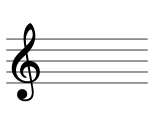
The treble clef, also called the G clef, is the sign at the start of a staff that places the note G4 (the G just above middle C) on the 2nd line. Its full name is “G clef on the 2nd line”. From that single reference, every other note gets its name by going up and down the staff. It is the most used clef in all Western music and almost always the first one people learn. It is one of the three clefs, together with the bass clef and the C clef.
Where does the treble clef go?
The loop or spiral of the sign curls around the 2nd line of the staff (counting from the bottom). That detail is not decoration: it marks exactly the line where G is. There was historically a G clef on the 1st line (the “French violin clef”), but it is no longer used, and when people say “treble clef” they always mean the one on the 2nd line.
Why the symbol is a “G”: where the treble clef comes from
The treble clef is not a whim: it is a letter G distorted by centuries of hand copying. In medieval notation, scribes wrote at the start of the line the letter that named the reference note, using the letter system we now call the English or lead-sheet system, in which G is the note G. Written quickly with a quill, that G was gradually stretched into the spiral we know.
This is why the clef is called the G clef (in Spanish, clave de Sol, after the fixed-do name Sol for G), and why its loop wraps exactly around the G line: it is what is left of the circle of the original G marking its own note. The same is true of the other two clefs, which come from F and C.
The system comes from the staff that is credited to Guido of Arezzo in the 11th century: the letter of the reference note was written on the lines, and the clefs came from there. Curiously, the G clef was the last to appear (the first ones used were the F and C clefs), and yet it is the most common of the three today.
How to draw the treble clef step by step
Drawing it well is not calligraphy: if the spiral does not wrap around the 2nd line, the clef stops meaning what it should. These five steps, in this order, work every time:
- Start at the bottom, in the space below the 1st line, with a small tail to the left.
- Go up in an almost straight line across the whole staff until you pass the 5th line.
- Turn at the top to the right and come down on the left side, crossing the stroke you just made around the 4th line.
- Open a wide arc to the left (the “belly” of the clef) and head back to the right when you reach the height of the 2nd line.
- Close the spiral by turning around the 2nd line so that the loop wraps it completely.
The most common mistake is closing the loop on the 1st or the 3rd line. If that happens, what you wrote is no longer a G clef on the 2nd line: always check that detail before moving on.
Printable worksheet: tracing the clef with decreasing help
For the youngest learners, reading the explanation is not enough: the clef has to be traced many times. This PDF worksheet takes the help away little by little — first the model, then the dotted clef to trace over, then with the dots farther and farther apart, then only the dot that marks the 2nd line, and finally the empty staff for drawing it on its own. The stroke is a single line, the one the pencil makes without being lifted: in printed scores the clef looks thicker because it is engraved.

Download the worksheet as a PDF (A4)
You may print and photocopy it freely for the classroom or for home. There are also the bass clef worksheet and the C clef worksheet.
Notes in the treble clef: how to read them all
The reference note is G on the 2nd line. From there, every note in the treble clef is read by going up or down from that position, in musical alphabetical order (C–D–E–F–G–A–B):
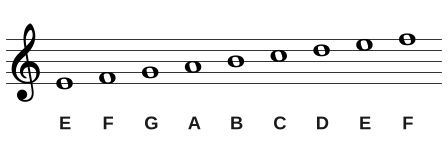
| Position (top to bottom) | Note |
|---|---|
| 5th line | F |
| 4th space | E |
| 4th line | D |
| 3rd space | C |
| 3rd line | B |
| 2nd space | A |
| 2nd line | G (reference) |
| 1st space | F |
| 1st line | E |
| 1st ledger line below | C (middle C) |
The fixed-do names used in Spanish-, French- and Italian-speaking countries are Do, Re, Mi, Fa, Sol, La, Si for C, D, E, F, G, A, B.
A trick to memorize them
A very common memory aid: the lines, from bottom to top, are E–G–B–D–F (“Every Good Boy Does Fine”); the spaces, from bottom to top, are F–A–C–E (they spell “FACE”). Memorizing those two sequences lets you find any note at a glance. To practice reading, you can also use the page on note names.
Practice now: which note is it?
Knowing the trick is not the same as reading fluently. That only comes with repetition. Try the exercises: identify notes in the treble clef or write notes in the treble clef.
Notes outside the staff: ledger lines
The staff has only five lines, but music does not stop there. When a note falls above or below, it gets a short line of its own: a ledger line. Ledger lines are always counted moving away from the staff, and you must draw all the ones in between: to reach the second you must first draw the first.
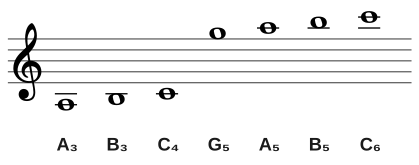
Two details worth fixing from the start:
- C4 (middle C) lives on the first ledger line below the staff. It is the note that links the treble clef with the bass clef: the same C is written just above the staff in the bass clef and just below it in the treble clef. (Octave numbers use scientific pitch notation; see octave numbering.)
- G5 does not need a ledger line. It goes in the space above the 5th line, still “inside” the system. The first note above the staff that does need a ledger line is A5.
Differences between the treble, bass and C clefs
The three clefs do not compete: they share out the range. Each puts its reference note on a different line so that the music of each instrument fits on the staff without filling up with ledger lines.
| Clef | Note it places | Line | Register | Who uses it |
|---|---|---|---|---|
| Treble (G) | G4 | 2nd | High and medium-high | Violin, flute, trumpet, right hand of the piano |
| Bass (F) | F3 | 4th | Low | Cello, double bass, tuba, left hand of the piano |
| C clef | C4 | 3rd or 4th | Medium | Viola, bassoon and trombone (high register) |
The practical consequence is the hardest thing to absorb at first: the same position on the staff is not always the same note. The 2nd line is G in the treble clef, but B in the bass clef. That is why you do not “read the staff”: you read the staff in a clef. You can see the three compared on the clefs page.
What is it for, and which instruments use it?
The treble clef comfortably covers the high and medium-high registers, keeping those notes centered on the staff without many ledger lines. It is used by:
- Bowed strings: violin and, in their high register, the viola and the cello.
- Plucked strings: guitar (written an octave higher than it sounds), ukulele, mandolin, banjo and the upper staff of the harp.
- Woodwinds: flute, piccolo, oboe, English horn, all the clarinets and all the saxophones.
- Brass: trumpet, cornet, flugelhorn, horn and, in the band tradition, also the euphonium when it is written in B♭.
- Keyboard: the right hand of the piano, the organ and the harpsichord (in the two-staff system).
- Pitched percussion: xylophone, vibraphone, marimba, glockenspiel and chimes.
- Voices: soprano, mezzo-soprano, alto and tenor. The tenor is the exception worth remembering: it sounds an octave lower than written.
That list explains why it is the first clef people learn: if you play a wind instrument in a band, you almost certainly read the treble clef. You can see the notes of each instrument on notes on instruments.
Common mistakes when learning the treble clef
Almost all beginner errors are the same five. Recognizing them saves weeks:
- Counting the lines from the top. In music, lines are always counted from the bottom. The “2nd line” is the second one starting from the very lowest, not the second one you see when you look at the score.
- Closing the spiral on the wrong line. If the loop wraps the 1st or 3rd line, what you wrote is no longer a G clef on the 2nd line and every note changes its name.
- Looking for middle C inside the staff. In the treble clef, C4 is outside, on the first ledger line below. It is the same note that appears just above the staff in the bass clef.
- Thinking all clefs are read the same way. The 2nd line is G in the treble clef and B in the bass clef. You do not read the staff: you read the staff in a clef.
- Skipping ledger lines when drawing them. To write on the second ledger line you must first draw the first; if one is missing, the note that is read is not the one you meant to write.