
The corneta is a brass instrument with a very Spanish life: Holy Week processions and the military. It has a trait almost no other instrument has: it cannot play every note. It has no holes and none of the three valves of the trumpet, so it plays only the notes of the harmonic series, doubled thanks to a part called the palometa. This page shows exactly which notes it plays, why those and no others, and why that explains the sound of Spanish processional marches.
A note on the name. The Spanish corneta on this page is a bugle-type instrument (conical bore, military calls, drum-and-bugle bands). It is not the English cornet, which Spanish players call cornetín: a three-valve B♭ brass instrument fingered like the trumpet. If you are looking for the three-valve cornet, there is a short summary below.


| Family | Brass (conical tube) |
|---|---|
| Pitch | C/D♭ (the one used in drum-and-bugle bands); also C/B♭ |
| Mechanism | A key or lever, the palometa (models with 1, 2 or 3 valves also exist) |
| Notes it plays | Harmonics only: those of C and those of D♭, depending on the palometa |
| Range | G4–F6 (C/D♭ corneta, sounding pitch) |
| Transposition | None: written in treble clef, as it sounds |
| Keys it favors | F minor, A♭ major, C minor and E♭ major |
| Also called | Holy Week corneta · signal corneta (military) |
Corneta, cornet (cornetín) or trumpet?
In Spanish the word corneta covers different things, and the English words do not line up with it:
- The corneta (this page) is the instrument of the drum-and-bugle bands and military calls: conical tube, dark and penetrating sound, and a palometa or a few valves. Its nearest English relative is the bugle.
- The cornet (Spanish cornetín) is a three-valve B♭ brass instrument of the wind band and the brass band. It plays every note, is fingered like the trumpet and has a mellow tone, a close cousin of the flugelhorn. Like the B♭ trumpet, it is a transposing instrument: it sounds a major 2nd (whole step, UK: tone) lower than written.
- The trumpet has a cylindrical tube: brighter and more direct.
In short: if you want three-valve fingerings, go to the trumpet page. If you want to know why a corneta plays only a few notes, keep reading.
Why the corneta plays only a few notes
On any brass instrument the sound starts with the lips vibrating in the mouthpiece, and with a fixed tube length only the notes of that tube's harmonic series can be produced. The trumpet fills the gaps between harmonics with three valves that lengthen the tube; the corneta has none. A saying sums it up: "the corneta has the register it has, and we cannot go beyond it."
It has few parts, and all of them matter:
- The mouthpiece, where the lips vibrate.
- The tudel (mouthpipe and tuning slide), the tube the air enters. Pull it out to lower the pitch, push it in to raise it.
- The palometa (the key), the mechanism that changes everything.
- The bell, which amplifies the sound at the end.
The palometa: two instruments in one
The palometa is a key that sends the air one way or another through the instrument. That is the whole trick of the corneta:
- In the "C" position, the air runs through the full tube, including the bomba, and the instrument sounds the harmonics of C.
- Turned, the air skips the bomba, the tube is shorter and the instrument sounds the harmonics of D♭ (on the C/D♭ corneta, the most common). The D♭ series is a half step (UK: semitone) higher, which is why that position uses the shorter tube.
It is the same idea as the thumb valve of the double horn: two instruments in one, switched with a single gesture. That is why the palometa is also called the transposer (transpositor).
The important point: the palometa does not add a note. It shifts the whole series by a half step. Turning it does not give you one extra pitch: it changes all the notes available at once.

The notes of the C/D♭ corneta
These are the sounding notes of each palometa position. The ordinal is the harmonic number in each series:
| Harmonic | Palometa in CC series | Palometa turnedD♭ series |
|---|---|---|
| 3rd | 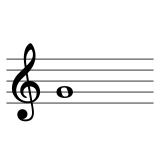 G4 | 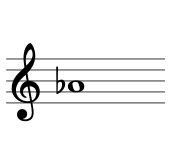 A♭4 |
| 4th | 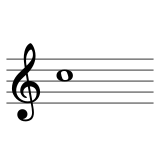 C5 | 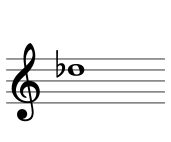 D♭5 |
| 5th | 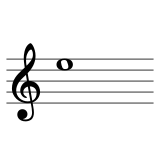 E5 | 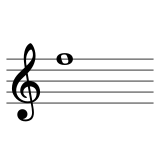 F5 |
| 6th | 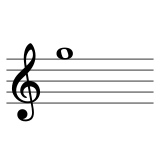 G5 | 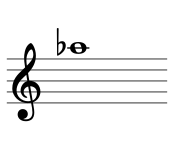 A♭5 |
| 7th | 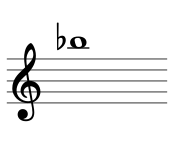 B♭5flat | 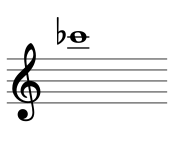 C♭6flat |
| 8th | 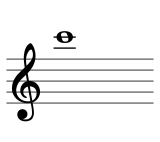 C6 | 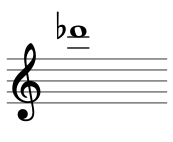 D♭6 |
| 9th | 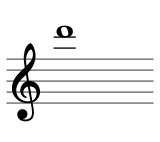 D6 | 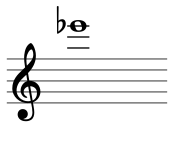 E♭6 |
| 10th | 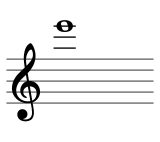 E6 | 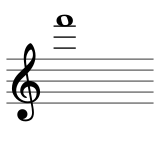 F6 |
The notes of the two series alternate: each one is a half step from the other. The 7th harmonic sounds naturally low (flat) and is hardly used. The corneta is written in treble clef and does not transpose.
In total the range is G4 to F6, from the G on the second line of the treble staff (UK: stave) to a very high F, in scientific pitch notation (C4 is middle C). The 7th harmonic is flat by about 31 cents compared with the B♭ of the piano, almost a third of a half step, so it is unusable against a tempered instrument. That is not the player's fault: it is the physics of the harmonic series, and the same happens on the trumpet and the horn. Below the 3rd harmonic are the pedal C and D♭ (the fundamental of the tube, a C3 of about 131 Hz). They exist, but they are poor and hardly used.
Try it: the corneta diagram
On a palometa corneta there are no fingerings: you only choose one of the two palometa positions and the harmonic you set with your lips. Pick a note to see which harmonic it is and where the palometa goes: the lever turns to horizontal in the D♭ series. Notice that the two series alternate note by note.
Printable worksheet (PDF)
The table of the 16 notes of the corneta, with their staff, on one side of A4 for the music stand. And a second sheet to fill in: the same staves with the note name left blank, to practice reading in treble clef. The reference sheet works as the answer key.

Download the notes (PDF) Download the fill-in sheet (PDF)
Why Holy Week marches sound like F minor
Put the two columns of the table together and look at the notes:
C · D♭ · D · E♭ · E♮ · F · G · A♭ · B♭
That is not an arbitrary collection: it is almost exactly the F natural and harmonic minor scales put together, with their four flats and the E natural as leading tone (plus a D, which is not in either scale). The C/D♭ corneta does not "choose" to play in F minor: it is the only thing it can play. The same notes also give the main chords and melodies of A♭ major, C minor and E♭ major.
That is why the Holy Week repertoire lives in those four keys, and why processional marches have that unmistakable color: it is not an aesthetic decision, it is the instrument. A composer writing for a drum-and-bugle band writes inside what the palometa allows.
Types of corneta
Everything above describes the C/D♭ palometa corneta, the most common in Spain. If yours has valves, you are not limited to the harmonics: the valves fill the gaps between them, and the more valves, the more notes.
There is not just one corneta. The two big families are the palometa (key) models and the valve models:
| Type | Mechanism | Range | Where it is used |
|---|---|---|---|
| C/D♭ corneta | Palometa | G4–F6 | The most common in drum-and-bugle bands |
| Bright C/D♭ | Palometa | A half step higher | Some bands (the other instruments must transpose) |
| C/B♭ corneta | Palometa | Lowest note F4 | Music groups and bands, depending on the repertoire |
| One valve | 1 valve | Depends on the model (C/D♭ or C/B♭) | Bands and music groups |
| Two valves | 2 valves | Reaches below the G4 | Bands and music groups |
| Three valves | 3 valves | The widest of all | The most versatile; close to the cornet |
The more valves, the more notes: the three-valve model already fills the gaps between harmonics and has the widest range. The C/B♭ corneta, with its palometa, combines the series of C and of B♭, a different color from the C/D♭ model, and starts sounding from F4.
Its role in the drum-and-bugle band
In a drum-and-bugle band (banda de cornetas y tambores) the C/D♭ cornetas carry the main melody (the first voice) and the others provide the harmonic accompaniment; depending on the piece there are three or more voices. When the corneta is used inside a music group that also has trumpets, the roles reverse: the trumpet carries the main voice and the corneta reinforces the melody, sounding higher and brighter in some passages, and supports the harmony.
A little history
The corneta began as a military instrument: a simple tube with no mechanism, used to send orders at a distance. With its few notes, dozens of calls were coded: march, halt, quicken the pace, salute the anthem, taps. Having few notes was not a defect, it was the point: a call had to be recognized from far away without doubt.
From the military world it passed to the drum-and-bugle bands of Holy Week, and something curious happened: its limited set of notes, far from being a problem, ended up defining a musical style of its own, that of processional marches. Once again: it is not an aesthetic decision, it is the instrument.
Common mistakes with corneta notes
- Looking for corneta fingerings. On a palometa corneta there are none: only two positions and the harmonic you set with your lips. If you want valve combinations, you want the trumpet or the cornet.
- Thinking the corneta is "out of tune". The 7th harmonic is flat because of physics, not because of you. It is the harmonic series, the same on every brass instrument.
- Mixing it up with the trumpet. They are different instruments: the corneta is conical with a palometa; the trumpet is cylindrical with three valves.
- Forcing notes outside the register. The pedal notes exist but sound poor; the instrument "has the register it has".
Summary
- The corneta is a conical brass instrument with no valves (or very few): it can play only the harmonics of its tube.
- The palometa switches between two series: C and D♭. Two instruments in one.
- The C/D♭ corneta, the most common in drum-and-bugle bands, covers G4 to F6.
- The two series together give the notes of F minor (and of A♭ major, C minor and E♭ major): that is why Holy Week marches are in those keys.
- The corneta is not the English cornet (three valves in B♭, like the trumpet) and it is not the trumpet.
The harmonics of each series were checked by calculation.