
The harmonic series is one of the foundations of all music: it explains where intervals come from, why each instrument has its own timbre, and how the trumpet, the clarinet or the harmonics of a string work.
What is a harmonic?
When an instrument plays a note, it does not produce a single frequency. It produces a main frequency, the fundamental, which is the one we hear as “the note”, and at the same time a series of much weaker, higher frequencies, the harmonics (also called partials or overtones). These harmonics are not random: they are whole-number multiples of the fundamental.
If the fundamental vibrates at 100 Hz, its harmonics vibrate at 200, 300, 400, 500 Hz… (2×, 3×, 4×, 5×…). That sequence, the fundamental and all its multiples, is the harmonic series. It is present in almost every sound with a definite pitch: a string, a column of air, the voice.
The harmonic series on C2
If we take C2 (65.4 Hz) as the fundamental and keep multiplying, these notes appear. Notice a key detail: the intervals between consecutive harmonics get smaller as we go up (octave, fifth, fourth, major third, minor third…).
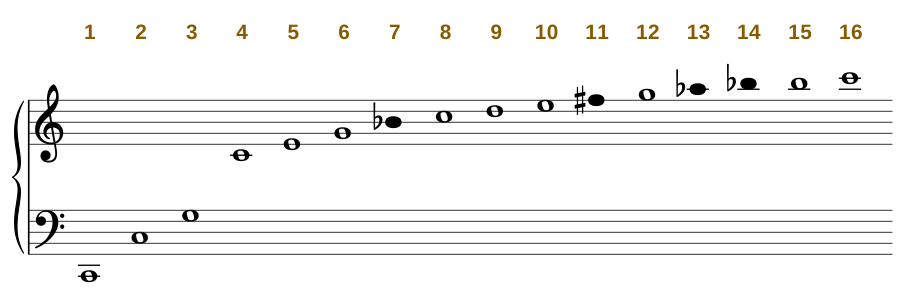
Listen to the harmonic series
This is the heart of the page. Press each harmonic to hear it and see it on the staff; you will also see the string vibrating in that number of parts. With the buttons you can play the whole series from low to high, or sound all the harmonics at once, which is basically what a timbre is.
The harmonic series, harmonic by harmonic
The same series, as a reference table. The “deviation” is how far each harmonic is from the nearest piano note (equal temperament): the ones that deviate most are the ones shown above with a filled notehead. One cent is one hundredth of a half step (UK: semitone).
| Harmonic | Note | Interval above the fundamental | Deviation |
|---|---|---|---|
| 1 | C | Fundamental | 0 |
| 2 | C | Octave | 0 |
| 3 | G | Perfect 5th (above the octave) | +2 ¢ |
| 4 | C | Two octaves | 0 |
| 5 | E | Major 3rd (above two octaves) | −14 ¢ |
| 6 | G | Perfect 5th (above two octaves) | +2 ¢ |
| 7 | B♭ | “Natural” minor 7th (above two octaves) | −31 ¢ |
| 8 | C | Three octaves | 0 |
| 9 | D | Major 2nd (above three octaves) | +4 ¢ |
| 10 | E | Major 3rd (above three octaves) | −14 ¢ |
| 11 | F♯ (approx.) | Augmented 4th (above three octaves) | −49 ¢ |
| 12 | G | Perfect 5th (above three octaves) | +2 ¢ |
| 13 | A♭ (approx.) | Minor 6th (above three octaves) | +41 ¢ |
| 14 | B♭ | Minor 7th (above three octaves) | −31 ¢ |
| 15 | B | Major 7th (above three octaves) | −12 ¢ |
| 16 | C | Four octaves | 0 |
Intervals are born from the harmonic series
Here is the remarkable part: the intervals we use in music are not an arbitrary invention. They appear by themselves between the first harmonics, as ratios of small numbers. The simpler the ratio, the more consonant the interval sounds.
| Between harmonics… | Interval | Ratio |
|---|---|---|
| 1 and 2 | Perfect octave | 2:1 |
| 2 and 3 | Perfect 5th | 3:2 |
| 3 and 4 | Perfect 4th | 4:3 |
| 4 and 5 | Major 3rd | 5:4 |
| 5 and 6 | Minor 3rd | 6:5 |
| 8 and 9 | Major 2nd (whole step; UK: tone) | 9:8 |
This is the basis of just intonation and the reason a fifth or an octave sounds so “pure”: their frequencies are in a simple mathematical relationship. It is also the physical origin of consonance and dissonance. (Do not confuse this with harmonic intervals, which are simply two notes sounding together: that is a different concept.)
The harmonic series and chords
Now look at harmonics 4, 5 and 6: they are C, E and G, that is, the major triad. The major chord is not a cultural convention: it appears by itself, and very early, inside the harmonic series of any note. That is why it sounds so stable and “resolved”, and why it is the foundation of triads and of all tonal harmony. If we keep going up, the 7th harmonic adds the seventh, the seed of the dominant seventh chord, and the 9th adds the ninth. Harmony, at bottom, is a matter of “stacking” harmonics.
The “out-of-tune” harmonics
Not all harmonics fit the equal-temperament system to which the piano is tuned. Three are especially rebellious:
- The 7th harmonic (a very low B♭, −31 cents): the famous “natural seventh”, lower than our B♭. Its flat color is often compared to the blue notes of blues and jazz.
- The 11th harmonic (halfway between F and F♯, −49 cents): it falls almost on a quarter tone, a “neutral” sound that does not exist on the keyboard.
- The 13th harmonic (a very high A♭, +41 cents): another “between the keys” note.
Even the natural major third, the one between harmonics 4 and 5 (ratio 5:4), is 14 cents below the equal-tempered one on the piano. That is why equal temperament is a compromise: it spreads small errors over all the notes so that we can play in any key. Harmonics remind us how “pure” tuning would sound.
Timbre: why a trumpet and a flute do not sound the same
If two instruments play the same C, why can we tell them apart? Because they sound the same fundamental but with a different mix of harmonics. That mix, which harmonics are strong and which are weak, is the timbre.
- The flute has relatively weak upper harmonics, especially in its low register, so its sound is pure and sweet.
- The clarinet emphasizes mainly the odd harmonics (1, 3, 5…): hence its hollow, round tone.
- The trumpet and the violin are rich in harmonics, which is why they sound bright and penetrating.
The mathematician Fourier showed that any periodic sound can be broken down into a sum of harmonics. When many harmonics are added together they stop sounding like separate notes and blend into a single timbre.
Harmonics in instruments
The harmonic series is not just theory: it is the physical basis of how many instruments are played.
Brass
A trumpet, a horn or a tuba, with a fixed length of tubing, can play only the harmonics of that tube: the player “jumps” from one to another by changing lip tension. Old natural trumpets and horns (without valves) had only those notes; that is why high Baroque melodies were written very high, where the harmonics are close together. Valves (or the trombone slide) lengthen the tube to provide several harmonic series and fill in the gaps.
Woodwinds
When overblowing, a woodwind jumps to a higher harmonic with the same fingering. The flute, the oboe and the saxophone jump to the octave (2nd harmonic). The clarinet, on the other hand, jumps to the twelfth (3rd harmonic), because its cylindrical tube, closed at one end, produces mainly odd harmonics: that is why it has a “register key” and a large jump between registers.
Strings and voice
On a string, if you touch it lightly exactly at the middle, instead of the full note you hear its octave (2nd harmonic): this is the natural harmonic (French: flageolet) of guitars, violins and harps. And with the voice, by shaping the harmonics in the mouth, you can produce overtone singing, in which one person makes two notes sound at once.
Tuned percussion
On a circular drumhead the vibration modes do not form a harmonic series: their frequencies fall in irregular proportions and the stroke has no clear pitch. The timpani are the exception, and not by chance: the air-filled kettle underneath and the place where the head is struck (near the edge, never in the center) reinforce some modes and damp others, leaving the four main ones in proportions very close to 2 : 3 : 4 : 5, like four consecutive harmonics. The ear takes the lowest of them as the note. That is why a timpani gives notes and a bass drum does not. → The notes of the timpani
A little history
The idea goes back a long way: Pythagoras (6th century BC) is traditionally credited with observing, with the monochord, that dividing a string in simple ratios (1:2, 2:3) gave the consonant intervals. In 1636 Marin Mersenne described for the first time that one string sounds several tones at once. Jean-Philippe Rameau based his whole theory of harmony on the corps sonore (the sounding body and its harmonics), and in the 19th century Hermann von Helmholtz showed that timbre depends on harmonic content. Behind it all is the mathematics of Fourier.
Common mistakes
- Confusing “harmonic” with “harmonic interval”. Here a harmonic is a natural component of a sound; a harmonic interval is simply two notes played at once.
- Thinking they exist only on strings. The harmonic series is in almost every pitched sound: winds, voice, struck or bowed strings.
- Thinking “just” tuning is always better. It is purer in an isolated chord, but it prevents changing key freely; that is why we use equal temperament.
- Counting the fundamental as “harmonic 0”. The fundamental is harmonic 1; the multiples start at 2.
In summary
- Every pitched sound is a fundamental plus a series of harmonics, which are its whole-number multiples (2×, 3×, 4×…).
- From the series come intervals (octave 2:1, fifth 3:2, fourth 4:3, major third 5:4…) and consonance.
- The mix of harmonics defines timbre: that is why each instrument sounds different.
- It is the physical basis of brass playing, of overblowing in woodwinds (octave, or twelfth on the clarinet) and of natural harmonics on strings.
- Some harmonics (7th, 11th, 13th) do not fit piano tuning: they are the “between the keys” notes.