
An interval is the distance between two notes. Depending on how those two notes are played, the interval can be melodic (one after the other) or harmonic (both at once). It is important to understand that this classification does not change the size of the interval: from C to G there is always a perfect 5th, however it sounds. The only thing that changes is how it is performed.
Melodic interval
In a melodic interval the two notes sound successively, one after the other. It is the basis of melody: when we sing or play a line of notes, we are chaining melodic intervals. On the staff (UK: stave), the notes are written one after the other.
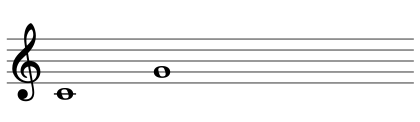
A melodic interval can be ascending, if the second note is higher than the first, or descending, if it is lower:
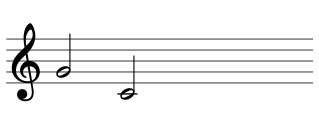
Depending on the distance between the two notes, a melodic interval can also be conjunct or disjunct (by step or by leap). And depending on its size it is also classified as simple or compound.
Harmonic interval
In a harmonic interval the two notes sound simultaneously, at the same time. It is the basis of harmony and of chords: stacking several harmonic intervals builds a chord. On the staff, the notes are written vertically aligned, one above the other.
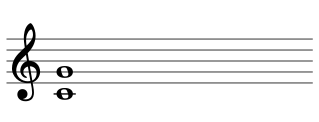
Comparison table
| Melodic interval | Harmonic interval | |
|---|---|---|
| How it sounds | One note after the other (successive) | Both at once (simultaneous) |
| Notation | Notes in a row, horizontally | Notes aligned vertically |
| It is the basis of… | Melody | Harmony and chords |
| Direction | Ascending or descending | Has no direction |
| Size | The same (a 5th is a 5th in both) | |
In short: melodic = succession, harmonic = simultaneity. To measure and name the interval (2nd, 3rd, 5th…) and its quality (major, minor, perfect…), the procedure is identical in both cases. You can review it on the page about musical intervals.