
Depending on the distance between its two notes, an interval is either conjunct or disjunct. This is a useful way to describe how a melody moves: does it go note by note (by step) or by leaps?
Conjunct interval
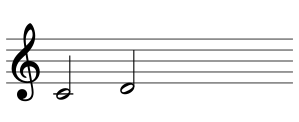
A conjunct interval (moving "by conjunct degrees", or by step) joins two neighboring notes of the scale, that is, a 2nd (major or minor). The two notes are next to each other, with no note between them. For example, from C to D:
Disjunct interval
A disjunct interval (a leap) joins two notes that are not neighbors: the melody skips one or more notes in between. It is any interval of a 3rd or larger. For example, from C to G (a 5th):
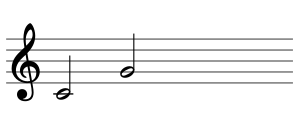
The boundary is simple: only the 2nd is conjunct; everything else (3rd, 4th, 5th, 6th…) is disjunct.
Stepwise and leaping motion in a melody
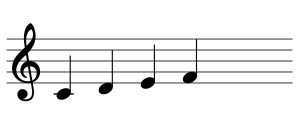
These two kinds of interval describe melodic motion. A melody that moves by steps (from 2nd to 2nd) sounds smooth, gradual and singable. For example, C–D–E–F:
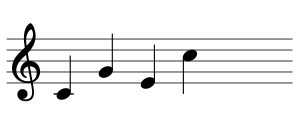
A melody that moves by leaps sounds more angular and energetic. It is typical of arpeggios and instrumental themes. For example, C–G–E–C:
Most melodies mix both: stepwise stretches give flow, and an occasional leap adds interest and expression.
Comparison table
| Conjunct | Disjunct | |
|---|---|---|
| Distance | 2nd (neighboring notes) | 3rd or larger (leap) |
| Notes in between | None | At least one is skipped |
| Melodic motion | Note by note, stepwise | By leaps |
| Character | Smooth, singable | Angular, energetic |
| Example | C–D | C–G |