
Musical sound has four qualities that define it completely: pitch, duration, intensity and timbre. Each one answers to a physical property of the vibration and is shown in a different way in the score.
What is musical sound?
Sound is the sensation produced in the ear by the vibration of an object, carried through the air as waves. Not every sound is musical: we speak of musical sound when the vibration is regular and produces a definite pitch, as opposed to noise, whose vibration is irregular. That vibration has four measurable features, and the four qualities come from them.
The four qualities
| Quality | What it tells you | Depends on | How it is notated |
|---|---|---|---|
| Pitch | Whether the sound is high or low | Frequency | The position of the note on the staff |
| Duration | How long the sound lasts | How long the vibration lasts | Note values and rests |
| Intensity | Whether it sounds loud or soft | Amplitude | Dynamics (p, f…) |
| Timbre | The color or character of the sound | Harmonics / waveform | The instrument or voice (no sign of its own) |
Pitch
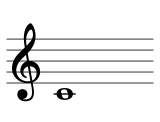
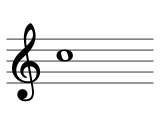
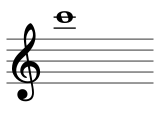
Pitch is the quality that tells us whether a sound is high or low. It depends on the frequency of the vibration, which is the number of oscillations per second, measured in hertz (Hz): the higher the frequency, the higher the sound. Pitch gives rise to notes and is shown by the position of the note head on the staff. The distance in pitch between two notes is an interval.
Press ▶ to hear the same C three times, each one an octave higher. Look at the frequencies: going up an octave doubles the frequency (261.6 → 523.3 → 1,046.5 Hz), and the note moves up on the staff. The reference note, A4, has a frequency of 440 Hz. It is the one the tuner uses.
Duration
Duration shows how long a sound lasts. It is the basis of rhythm and is written with note values (whole note, half note, quarter note…) and their rests, whose relative values are measured inside the measure (UK: bar).
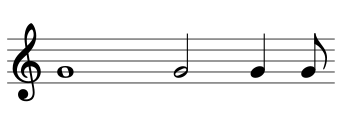
Each note value lasts half as long as the one before: a whole note equals two half notes, four quarter notes and eight eighth notes. Only the duration changes; the pitch, intensity and timbre stay the same. You can practice this in the note value exercises.
Intensity
Intensity tells us whether a sound is loud or soft. It depends on the amplitude of the vibration: the greater the amplitude, the greater the volume. In the score it is shown with dynamics, written with Italian abbreviations: pp (pianissimo), p (piano), mp (mezzo piano), mf (mezzo forte), f (forte) and ff (fortissimo), plus hairpins for crescendos and diminuendos. All the dynamic marks are explained on the page about dynamics.
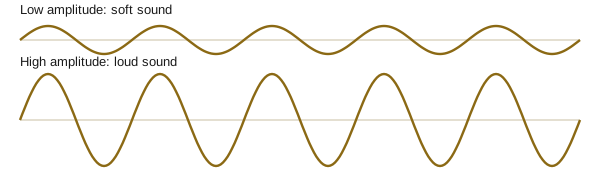
Two sounds can have exactly the same frequency (the same note) and differ only in amplitude. This is what changes when you play the same note piano and forte. There is no audio here on purpose: the volume you hear depends on your speakers or headphones, so we draw it instead of playing it.
Timbre
Timbre (also called tone color) is the color or character of each sound. It is what lets you tell a violin from a flute, or one person's voice from another's, even when they play exactly the same note at the same intensity. It depends on the harmonics that accompany the fundamental sound and on the shape of the wave. It has no sign of its own in the score; it comes from the instrument or voice that performs the music.
The same note on different instruments
A musical sound is not a single frequency. The instrument produces a fundamental (the sound that gives the note its name; here, A4 at 440 Hz) and several harmonics, which are multiples of that frequency (880, 1,320, 1,760 Hz…). What changes from one instrument to another is how much energy each harmonic carries, and that balance is the timbre. A clarinet, for example, strengthens the odd-numbered harmonics in its low register, while a trumpet has many strong harmonics. How this series is produced is explained on the page about the harmonic series.
Press an instrument: you will hear the same A4 and see its harmonics, measured on our own samples.
How to tell the four qualities apart
A trick to avoid mixing them up: change one and keep the other three the same.
- Pitch: two different notes on the same instrument, with the same duration and the same volume. One sounds higher than the other.
- Duration: the same note, one long and one short.
- Intensity: the same note, one soft and one loud.
- Timbre: the same note, with the same duration and volume, played by a flute and by a clarinet.
Each one is studied in its own part of music theory: pitch in notes and intervals; duration in note values and time signatures; intensity in dynamics; and timbre in the instruments, such as the page on clarinet notes.