
Dynamics are the degree of intensity or volume with which music is played, and the signs that show them are called dynamic markings. Dynamics are one of the qualities of sound (intensity) and one of the most important expressive tools: the same melody sounds completely different played pianissimo or fortissimo. Dynamic markings are written as Italian abbreviations.
The levels of intensity
From softest to loudest, the basic dynamic markings are:
| Symbol | Italian term | Meaning |
|---|---|---|
| ppp | pianississimo | as soft as possible |
| pp | pianissimo | very soft |
| p | piano | soft |
| mp | mezzo piano | moderately soft |
| mf | mezzo forte | moderately loud |
| f | forte | loud |
| ff | fortissimo | very loud |
| fff | fortississimo | as loud as possible |
The border between soft and loud lies between mp and mf. The “p” comes from piano (soft) and the “f” from forte (loud); repeating the letter strengthens the marking.

Where dynamics are written and how long they last
In instrumental scores, dynamic markings are written below the staff, right under the note where they begin. In vocal music, because the lyrics go underneath, they usually go above, and in piano music, which has two staves, they go between the two.
A dynamic marking lasts until another one appears: if a piece starts at mf, everything is played mezzo forte until the next sign, and there is no need to repeat it in every measure (UK: bar).
Dynamics are relative
Dynamic markings are not decibels: there is no exact volume for a forte. It depends on the instrument (a tuba's piano is not a piccolo's), on the hall and on the context: an f that comes after a pp sounds louder than the same f after an ff. What matters is the proportion: each marking must sound clearly different from its neighbors, especially at the border between mp and mf.
In a band or an orchestra, the marking also belongs to each instrument: if a flute carries the melody at mf, the brass accompaniment, even if it is also marked mf, usually has to play a little softer so the melody can be heard. This is called balance and it is worked on in rehearsal.
Gradual changes: crescendo and diminuendo
When the intensity must change little by little, hairpins (angle-shaped signs) or the Italian words are used:
- Crescendo (cresc.) — a hairpin that opens: gradually increase the volume.
- Diminuendo or decrescendo (dim. / decresc.) — a hairpin that closes: gradually decrease the volume.

A hairpin usually goes between two dynamic markings, and those two markings say where it starts and ends: in p < f the sound grows from soft to loud. When the change lasts several measures, the word (cresc., dim.) is written followed by a dotted or dashed line that shows how far it goes.
There are also terms that shape the end of a sound or phrase, such as morendo (dying away), calando (growing softer and slower) or perdendosi (fading away), which combine a drop in volume with a drop in tempo.
Sudden changes and accents
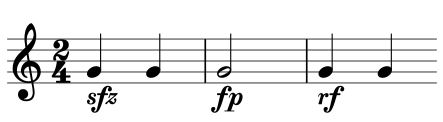
Some signs show a sudden change, not a gradual one:
- sf or sfz (sforzando): a sudden, forceful accent on a note or chord.
- fp (fortepiano): attack loud and drop immediately to soft.
- rf or rinf. (rinforzando): briefly reinforce a group of notes.
- subito (sub.): suddenly; for example subito piano = switch to soft all at once.
A little history
In the Baroque period dynamics were written only occasionally, and when they appeared it was to contrast loud and soft passages suddenly, which is called terraced dynamics. One of the first works with marked dynamics is Giovanni Gabrieli's Sonata pian' e forte (1597). The gradual crescendo and diminuendo became widespread in the 18th century, with the Mannheim orchestra, and since the Romantic period composers have asked for ever more extreme markings, even pppp or ffff.
Common mistakes with dynamics
- Playing everything at the same volume. Most dynamics problems come from a lack of contrast: between p and f there has to be a difference you can hear.
- Mixing up mp and mf. They are neighbors, but one is on the soft side and the other on the loud side.
- Spending the crescendo too early. If you reach f halfway through the hairpin, there is nothing left for the end.
- Holding a sfz. A sforzando is an accent on a single note or chord; afterwards you go back to the previous dynamic.
- Reading fp backwards. You attack loud and drop to soft right away, not the other way around.
Practice dynamics
Dynamics always combine with note values, the meter and the tempo to give music its expressive shape; they affect intensity, one of the four qualities of sound, along with pitch, duration and timbre.