
To analyze a time signature, you read its two stacked numbers at the beginning of the score and work out four key facts: whether the meter is simple or compound, how many beats each measure (UK: bar) has, what the beat unit is, and what the subdivision unit is. Each step is explained below.
Analyzing a time signature takes four steps:
- Decide whether it is simple or compound by looking at the top number (2, 3 or 4 → simple; 6, 9 or 12 → compound).
- Count the beats in each measure.
- Identify the beat unit: the note value that lasts one beat.
- Identify the subdivision unit: the note value each beat is divided into.
What does each number mean?
The top number (numerator) tells you how many times the bottom number's note value fits in the measure.
The bottom number (denominator) stands for a note value. It tells you how many notes of that value fit in a whole note (UK: semibreve):
- 1 = whole note
- 2 = half note (UK: minim)
- 4 = quarter note (UK: crotchet)
- 8 = eighth note (UK: quaver)
- 16 = sixteenth note (UK: semiquaver)
- 32 = thirty-second note (UK: demisemiquaver)
- 64 = sixty-fourth note (UK: hemidemisemiquaver)
Common time (C) and cut time (¢)
Besides numbers, there are two symbols, inherited from early notation, that stand in for certain time signatures:
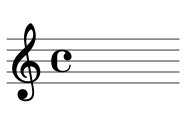
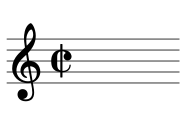
The C (common time) equals 4/4. The crossed C (cut time or alla breve) equals 2/2: the same music is counted in two half-note beats instead of four quarter-note beats, which gives it a lighter, quicker feel.
Simple or compound meter
To decide whether a meter is simple or compound, look at the top number:
- If the top number is 2, 3 or 4, the meter is simple.
- If the top number is 6, 9 or 12, the meter is compound.
Number of beats
If the meter is simple
The top number gives the number of beats directly.
Examples:
- 2/4 → 2 beats
- 2/1 → 2 beats
- 3/1 → 3 beats
- 4/16 → 4 beats
If the meter is compound
Divide the top number by 3 to get the number of beats.
Examples:
- 6/4 → 2 beats (6÷3)
- 6/2 → 2 beats (6÷3)
- 9/8 → 3 beats (9÷3)
- 12/16 → 4 beats (12÷3)
Beat unit
To find the note value of one beat, first decide whether the meter is simple or compound.
If the meter is simple
The bottom number gives the beat unit directly: the note value that matches that number is one beat.
Examples:
- 3/2 → beat unit: half note
- 4/1 → beat unit: whole note
- 2/16 → beat unit: sixteenth note
If the meter is compound
Take the note value that matches the bottom number, move up one step in the scale of note values, and add a dot.
Examples:
- 6/2 → beat unit: dotted whole note
- 9/4 → beat unit: dotted half note
- 12/16 → beat unit: dotted eighth note
Subdivision unit
The subdivision unit is the note value that each beat is divided into.
If the meter is simple
Start from the beat unit and move down one step in the scale of note values.
Examples:
- 4/16 → subdivision unit: thirty-second note
- 3/2 → subdivision unit: quarter note
- 2/8 → subdivision unit: sixteenth note
If the meter is compound
The bottom number itself gives the subdivision unit.
Examples:
- 6/4 → subdivision unit: quarter note
- 9/2 → subdivision unit: half note
- 12/8 → subdivision unit: eighth note
Measure unit
The measure unit is the total length of one whole measure. You get it by multiplying the beat unit by the number of beats.
Examples:
- 2/2 → measure unit: whole note
- 3/8 → measure unit: dotted quarter note
- 6/4 → measure unit: dotted whole note
- 9/16 → measure unit: dotted quarter note tied to a dotted eighth note
Table of the most common time signatures
The following table sums up the full analysis of the most common time signatures in Western music:
| Time signature | Type | Beats | Beat unit | Subdivision unit |
|---|---|---|---|---|
| 2/4 | Simple duple | 2 | Quarter note | Eighth note |
| 3/4 | Simple triple | 3 | Quarter note | Eighth note |
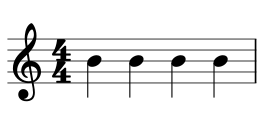
| 4/4 | Simple quadruple | 4 | Quarter note | Eighth note |
| 2/2 | Simple duple | 2 | Half note | Quarter note |
| 3/2 | Simple triple | 3 | Half note | Quarter note |
| 3/8 | Simple triple | 3 | Eighth note | Sixteenth note |
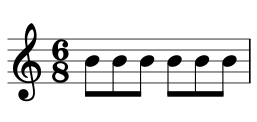
| 6/8 | Compound duple | 2 | Dotted quarter note | Eighth note |
| 9/8 | Compound triple | 3 | Dotted quarter note | Eighth note |
| 12/8 | Compound quadruple | 4 | Dotted quarter note | Eighth note |
| 6/4 | Compound duple | 2 | Dotted half note | Quarter note |
| 9/4 | Compound triple | 3 | Dotted half note | Quarter note |
| 12/16 | Compound quadruple | 4 | Dotted eighth note | Sixteenth note |
Duple, triple and quadruple
Besides simple or compound, meters are classified by the number of beats:
- Duple: 2 beats. Strong-weak accents (2/4, 6/8).
- Triple: 3 beats. Strong-weak-weak accents (3/4, 9/8). Typical of waltzes.
- Quadruple: 4 beats. Strong-weak-medium-weak accents (4/4, 12/8). The most common meter in popular music.
To identify the time signature step by step, practice with the interactive time signature analysis exercises, which show you the numbers and check your answer. See also the full catalog of time signatures with examples of each category.
Irregular (asymmetrical) meters
Some meters are neither purely simple nor purely compound, because they combine groups of different lengths. These are irregular or asymmetrical meters, with top numbers such as 5 or 7. Their beats are grouped unevenly:
- 5/8: grouped as 2+3 or 3+2 eighth notes.
- 7/8: grouped as 2+2+3, 3+2+2, and so on.
They appear in traditional music (such as the Basque zortziko, in 5/8), in Balkan folk music and in progressive rock.