
6/8 time is a compound meter with two beats. Although the top number says that six eighth notes (UK: quavers) fit in each measure (UK: bar), it is not counted in six but in two pulses, each equal to a dotted quarter note (UK: dotted crotchet). It is one of the most common meters in traditional and popular music, and it is responsible for the characteristic sway of jigs, barcarolles and ballads.
What does 6/8 mean?
In the time signature, the top number 6 tells you how many eighth notes fit in each measure, and the bottom number 8 says the reference note value is the eighth note (one eighth of a whole note). But those six eighth notes are not six beats: they group in threes to form two beats. That is why 6/8 is a compound meter and is counted in two.
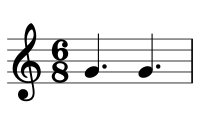
How to count 6/8
Each of the two beats divides into three eighth notes (ternary subdivision). The usual way to count aloud is "1 2 3 – 4 5 6", stressing the 1 (the strong beat) and, less strongly, the 4 (the second beat). At a fast tempo, those two accents, on 1 and 4, are all you feel, which is why 6/8 feels like counting in two.
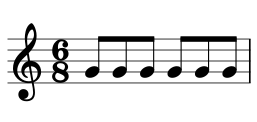
Why isn't 6/8 counted in six?
Because the six eighth notes are not six beats, but the subdivision of two. Counting "1-2-3-4-5-6" would count the eighth notes (the subdivision), not the pulse. At any tempo that is not very slow, the ear hears only two accents, on the first and fourth eighth notes, just as when walking you feel two steps and not the six movements that make them up. Only in practice, at a very slow tempo, do you count all six eighth notes to place each note precisely. As soon as the tempo rises, you feel it "in two" again.
The beat is the dotted quarter note
The beat unit of 6/8 is not the single eighth note but the dotted quarter note, which equals exactly three eighth notes. This is what separates compound meters from simple ones: in a simple meter such as 2/4 the beat is a quarter note (two eighth notes), while in 6/8 the beat "has a dot" because it divides into three.
| Element | In 6/8 |
|---|---|
| Type of meter | Compound (duple) |
| Beats per measure | 2 |
| Beat unit | Dotted quarter note |
| Subdivision of each beat | 3 eighth notes (ternary) |
| Eighth notes per measure | 6 (grouped 3+3) |
| Accent pattern | Strong – Weak |
Example melody in 6/8
This short melody in C major shows the rocking character of 6/8. Notice how the eighth notes group in threes, and how the final measure resolves on two dotted quarter notes, one per beat:

Where is 6/8 used?
6/8 appears whenever the music calls for a flowing, undulating movement. Some typical examples:
- Jig (gigue): the Celtic and Irish dance par excellence, fast and bouncy.
- Barcarolle: the rocking of the water, as in the songs of Venetian gondoliers.
- Tarantella: a lively Italian dance, usually written in fast 6/8.
- Ballads and lullabies: the sway of 6/8 gives a rocking feeling, ideal for cradle songs.
- Pop and rock: slow ballads with a steady triplet feel are written in 6/8 or in 12/8.
6/8 compared with 3/4: they are not the same
This is the most common confusion, because both contain six eighth notes. The difference is in the grouping: 3/4 has three beats with a binary subdivision (2+2+2), while 6/8 has two beats with a ternary subdivision (3+3). That is why the waltz (3/4) has a clear triple pulse and 6/8 sounds rocking. This difference is explained in detail, with an accent table, on the page about accents in compound meters.
To train this difference by ear, try the listening exercise recognize the meter by ear, which has melodies in 6/8, 3/4 and the other simple and compound meters.
How to practice 6/8
The best way to absorb the sway of 6/8 is to practice with a steady pulse. On the online metronome with 6/8 already selected you hear the accent on the first beat of each group. Start at a comfortable tempo (around 60–80 BPM per dotted quarter note) and speed up gradually until you feel the two accents without counting the six eighth notes. To check whether a melody is correctly written in 6/8, you can also use the time signature analyzer.