
The rhythmic accents of compound meters describe how strong and weak beats are distributed when the subdivision is triple. In practice the most common ones have 6, 9 or 12 as the top number, but their defining feature is that each beat divides into three equal parts (triple subdivision). Understanding this distribution is essential for syncopation and off-beat notes. To see how it works in simple meters, read accents in simple meters.
This accent on the first beat is what lets you recognize the meter by ear. You can practice with the ear-training exercise recognize the meter by ear.
Summary of accents in compound meters
| Time signature | Beats | Beat 1 | Beat 2 | Beat 3 | Beat 4 | Typical styles |
|---|---|---|---|---|---|---|
| 6/8 | 2 triple beats | Strong (S) | Weak (W) | — | — | Jig, tarantella |
| 9/8 | 3 triple beats | Strong (S) | Weak (W) | Weak (W) | — | Some Baroque dances, folk music |
| 12/8 | 4 triple beats | Strong (S) | Weak (W) | Medium (M) | Weak (W) | Slow ballad, blues |
The essential difference from simple meters is the subdivision: in compound meters each beat divides into three equal parts (eighth notes in 6/8, 9/8 and 12/8; UK: quavers), while in simple meters it divides into two. When that triple subdivision is altered by putting two notes where three would fit, you get a duplet, the tuplet typical of compound meters.
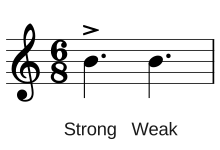
Compound meter with 2 beats (6/8)
Two triple beats: the first is strong and the second is weak (S-W). Each beat is a dotted quarter note (UK: dotted crotchet), which equals three eighth notes. This is the pattern of the jig and the tarantella. See the page on the 6/8 time signature, with examples on the staff.
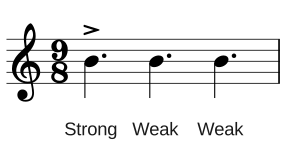
Compound meter with 3 beats (9/8)
Three triple beats: the first is strong and the other two are weak (S-W-W). It appears in some Baroque dances and in a lot of folk music.
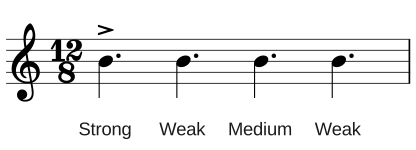
Compound meter with 4 beats (12/8)
Four triple beats: the first is strong, the third is medium-strong, and the second and fourth are weak (S-W-M-W). It is typical of slow ballads and of a lot of blues and slow rock.
The accent pattern repeats inside each beat
As in simple meters, inside each beat the first of its three subdivisions (eighth notes) gets a small relative accent and the other two are lighter. This inner pattern does not replace the main accent of the measure, which always falls on the first beat.
Why is 6/8 not the same as 3/4?
This is the most common confusion, because both contain six eighth notes. The difference is in how they are grouped:
- 3/4: three beats, each divided into two (duple subdivision). The eighth notes are grouped 2+2+2.
- 6/8: two beats, each divided into three (triple subdivision). The eighth notes are grouped 3+3.
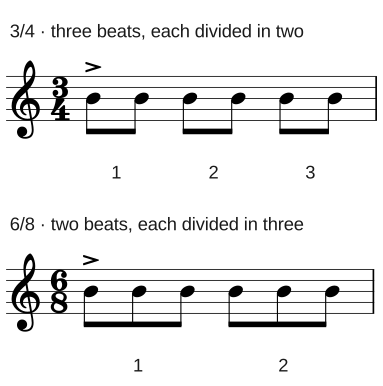
That is why 6/8 sounds more flowing and rocking, like Irish jigs and barcarolles, while 3/4 gives a clear three-beat pulse, like the waltz.
Simple and compound meters side by side
Every compound meter has a simple "twin" with the same number of beats and the same hierarchy of accents. The only thing that changes is the subdivision: duple in the simple meter, triple in the compound one.
| Simple meter | Compound meter | Beats | Accent pattern |
|---|---|---|---|
| 2/4 | 6/8 | 2 | S-W |
| 3/4 | 9/8 | 3 | S-W-W |
| 4/4 | 12/8 | 4 | S-W-M-W |
Check yourself: what accent pattern does 12/8 have?
Four triple beats with the pattern S-W-M-W (strong, weak, medium-strong, weak), the same as its simple twin, 4/4.
In summary
In compound meters the hierarchy of beats is the same as in the equivalent simple meters; what changes is that each beat divides into three equal parts. This triple subdivision gives a more rocking rhythmic feel and affects how syncopation, off-beat notes and tuplets are written.