
The duplet (Spanish: dosillo) is a tuplet: two equal notes played in the time that three notes of the same kind would normally take. In other words, it splits into two equal parts a beat that naturally divides into three, and that is why it belongs to compound meters. It is marked with the number 2 over the group. It is the rhythmic opposite of the triplet: a triplet brings a ternary division into a simple meter, while a duplet brings a binary division into a compound meter.
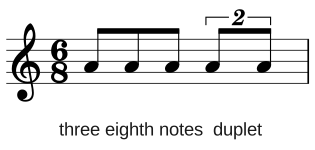
Three eighth notes versus a duplet
In a compound meter such as 6/8, each beat is three eighth notes (UK: quavers). The duplet fits two where those three would go, sharing the same beat between two equal notes:
How it is written: the bracket and the number 2
A duplet carries a number 2 over the group. With eighth or sixteenth notes joined by a beam, the beam itself groups the notes and the 2 above is usually enough. With separate note values (quarter notes, half notes) a bracket is added over the group, with the 2 in the middle.
How to count a duplet
The trick is to divide the beat into two perfectly equal parts instead of the usual three. Because the beat is ternary, the two notes of the duplet are "slower" than regular eighth notes and give a brief binary feel inside ternary music.
How to practice a duplet
- Mark the beat with the metronome at a slow tempo.
- First feel the three eighth notes of each beat.
- Replace those three eighth notes with two perfectly equal notes that fill the same space.
- Repeat very slowly and raise the tempo only when it sounds even.
Types of duplet
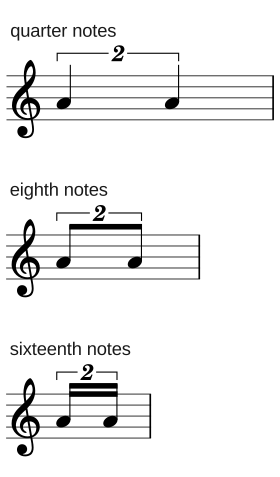
Any note value can take a duplet. Because it replaces three notes of its own kind, a duplet always equals a dotted note value:
| Duplet | It is... | Equals |
|---|---|---|
| Quarter-note duplet | 2 quarter notes | a dotted half note (3 quarter notes) |
| Eighth-note duplet (the most common) | 2 eighth notes | a dotted quarter note (3 eighth notes) |
| Sixteenth-note duplet | 2 sixteenth notes | a dotted eighth note (3 sixteenth notes) |
Duplet and triplet: they are opposites
The duplet and the triplet are two sides of the same coin: each one "lends" a meter the subdivision of the other.
| Triplet | Duplet | |
|---|---|---|
| Fits... | 3 notes | 2 notes |
| ...in the time of | 2 | 3 |
| Number | 3 | 2 |
| Typical of | simple meters | compound meters |
| Effect | ternary feel in a binary meter | binary feel in a ternary meter |
That is why a duplet makes no sense in a simple meter (its subdivision is already binary): the duplet only adds something where the natural division is ternary.
Where is the duplet used?
It appears in works in 6/8, 9/8 or 12/8 when the composer wants to briefly break the ternary swing with a pulse of two: to highlight a word, soften a melodic gesture or create an expressive contrast. It is especially common in vocal and choral music, where the text sometimes calls for two syllables in the space of three, and in lyrical passages of the Romantic period.
Why is the duplet much less common?
Because the vast majority of Western music is written in simple meters, which have a binary subdivision. There, the "extra" group that is needed is the one of three, so the triplet appears all the time. The duplet only makes sense in compound meters, which are far fewer, so it is seen much less often.