
The rhythmic accents of simple meters describe how strong and weak beats are distributed inside each measure (UK: bar). This is the basis of musical meter: the ear groups the pulse into measures because the first beat, the strongest, marks the start of each one. Simple meters are the ones whose top number is 2, 3 or 4. Understanding this distribution is essential for syncopation, for off-beat notes, and for analyzing any time signature. To see how it works in compound meters, read accents in compound meters.
This accent on the first beat is what lets you recognize the meter by ear. You can practice with the ear-training exercise recognize the meter by ear.
Summary of accents in simple meters
| Time signature | Beat 1 | Beat 2 | Beat 3 | Beat 4 | Typical styles |
|---|---|---|---|---|---|
| 2/4 (duple) | Strong (S) | Weak (W) | — | — | Pasodoble, march, polka |
| 3/4 (triple) | Strong (S) | Weak (W) | Weak (W) | — | Waltz, minuet |
| 4/4 (quadruple) | Strong (S) | Weak (W) | Medium (M) | Weak (W) | Pop, rock, blues |
The key difference from compound meters is that in simple meters each beat divides into two equal parts, while in compound meters it divides into three. When that duple subdivision is broken for a moment by putting three notes where two would fit, you get a triplet, the most common tuplet in these meters.
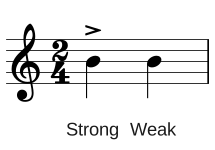
Simple meter with 2 beats (2/4)
Two beats: the first is strong and the second is weak (S-W). This is the simplest scheme. It is typical of the pasodoble (a Spanish march-like dance), the march and the polka.
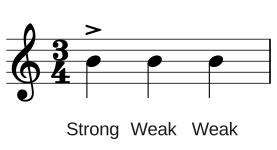
Simple meter with 3 beats (3/4)
Three beats: the first is strong and the other two are weak (S-W-W). This is the characteristic pattern of the waltz and the minuet.
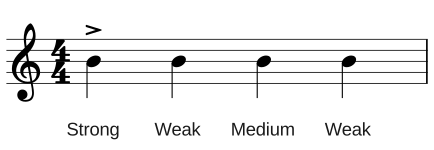
Simple meter with 4 beats (4/4)
Four beats: the first is strong, the third is medium-strong (a lighter secondary accent), and the second and fourth are weak (S-W-M-W). It is the most used meter in pop, rock and blues.
How it feels when you count
The easiest way to internalize the accents is to count out loud, stressing the first beat (in capitals, the strongest):
- 2/4: ONE-two · ONE-two
- 3/4: ONE-two-three · ONE-two-three (the sway of the waltz)
- 4/4: ONE-two-THREE-four (the "THREE" is the secondary, medium-strong accent)
The accent pattern repeats inside each beat
The same principle works at every level of the measure. Inside each beat, its first half is strong compared with the second; and inside each half, the first subdivision is strong compared with the next. So although the main accent always falls on the first beat, every fraction has its own small strong-weak accent. Performers feel this hierarchy naturally, and it is what gives rhythm its natural flow.
How do accents differ in simple and compound meters?
The hierarchy of accents is the same; what changes is the subdivision. In simple meters each beat divides into two equal parts; in compound meters it divides into three, which gives a more swaying feel. That is why every simple meter has a compound "twin" with the same number of beats and the same accent pattern:
| Simple meter | Compound meter | Beats | Accent pattern |
|---|---|---|---|
| 2/4 | 6/8 | 2 | S-W |
| 3/4 | 9/8 | 3 | S-W-W |
| 4/4 | 12/8 | 4 | S-W-M-W |
Conclusion
The rhythmic accents of simple meters organize the beats in a regular way, which makes the music easier to read and to perform. Identifying the strong and weak beats in 2/4, 3/4 and 4/4 is one of the first steps to understanding rhythm and how note values combine inside each measure.