
A triplet is a tuplet: three equal notes played in the time normally taken by two notes of the same kind. In other words, it divides a beat (or a note) into three equal parts instead of two, which is how you place a group of three inside simple meter. It is marked with a number 3 over the group, usually with a bracket or under the same beam.
Two eighth notes versus a triplet
The easiest way to understand it is to compare a beat divided in two (the normal division in simple meter) with the same beat divided in three by a triplet. Both last exactly the same amount of time:
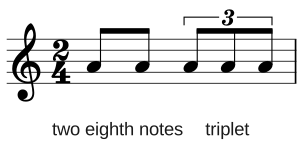
How it is written: the bracket and the number 3
A triplet always has a number 3. What changes is what goes with it:
- With notes that are joined by a beam (eighth notes, sixteenth notes), the beam already groups the notes, so the 3 above the group is usually enough, with no bracket.
- With separate notes (quarter notes, half notes), or when the group mixes notes and rests, a bracket is added over the whole group, with the 3 in the middle.
The number and bracket go on the stem side of the notes, almost always above the group.
How to count and play a triplet
To play it, divide the beat into three perfectly equal parts instead of two. A reliable trick is to say a three-syllable word on each beat, spread evenly. The most common choice is the word “trip-a-let”:
- Normal beat (two parts): “ONE – and”.
- Triplet (three equal parts): “TRIP-a-let”.
The most common mistake is to squeeze the last two notes together so the triplet turns into a dotted rhythm. All three notes must be spaced exactly evenly.
To play it accurately, start very slowly, say “trip-a-let” out loud, and use the metronome at a comfortable tempo before speeding up. The slower you practice, the more even the three notes will be.
Types of triplet
Any note value can be turned into a triplet. A triplet always equals two notes of the same kind:
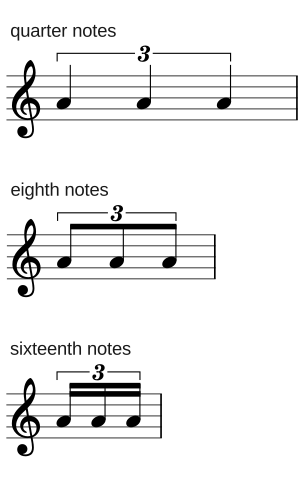
| Triplet | It is… | It takes the time of |
|---|---|---|
| Half-note triplet | 3 half notes | a whole note (2 half notes) |
| Quarter-note triplet | 3 quarter notes | a half note (2 quarter notes) |
| Eighth-note triplet (the most common) | 3 eighth notes | a quarter note (2 eighth notes) |
| Sixteenth-note triplet | 3 sixteenth notes | an eighth note (2 sixteenth notes) |
A triplet can also contain rests or tied notes instead of three separate notes, as long as together they add up to the value of three.
Triplet and 6/8: they are not the same
This is the most common confusion, because in both cases you hear groups of three. The difference is whether that division into three is the exception or the rule:
- Triplet: appears occasionally inside simple meter, whose natural subdivision is into two. The “3” warns you that here, and only here, the beat is divided in three.
- 6/8 and other compound meters: the division into three is the norm for the whole measure (UK: bar), so no “3” needs to be written.
The “Latin tresillo”: a rhythmic cell (that is not a triplet)
To avoid confusion: the tresillo (also called the Cuban tresillo) is a rhythmic pattern that splits the eight eighth notes of a 4/4 measure into groups of 3 + 3 + 2. Strictly speaking it is not a tuplet, because it does not divide any beat into three in an irregular way. It is a rhythmic cell whose name comes from the Spanish word for triplet because it groups the eighth notes in threes.
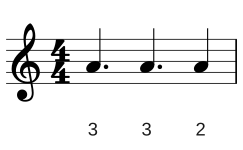
It is the rhythmic basis of the habanera and of the Cuban son, and it appears in many Latin styles. Tito Puente’s “Oye cómo va” is built on it.
Where are triplets used?
Triplets (the tuplet kind) are everywhere: in the swing and shuffle feel of jazz and blues, in many ballads, and in countless popular melodies. In classical music they are just as common: the first movement of Beethoven’s Moonlight Sonata is built almost entirely on eighth-note triplets, and Chopin’s nocturnes use them constantly in the accompaniment. A single triplet can completely change the rhythmic feel.
Common mistakes
- Confusing it with compound meter: a triplet is occasional; 6/8 divides the whole measure in three.
- Thinking triplets are always eighth notes: there are quarter-note, sixteenth-note and half-note triplets too.
- Thinking “triplet” means three fast notes: what matters is that the three notes fill the time of two, not that they are quick.
- Squeezing the last two notes: all three must last exactly the same time.
Practice: internalize the triplet rhythm with the online metronome. Set it slow and count “trip-a-let” on every beat until the three notes sound perfectly even.