
Tuplets (also called irregular groups or artificial groups; in Spanish, grupos de valoración especial) are groups of notes that temporarily change the normal division of a note value. Instead of splitting a value into the number of notes that the meter would normally give, they fit more (or fewer) notes into the same space. The best known is the triplet, but there are also the duplet, the quadruplet, the quintuplet, the sextuplet and the septuplet, among others.
What is a tuplet?
Normally, each note value divides into equal parts that are powers of two: a quarter note (UK: crotchet) into two eighth notes (UK: quavers), an eighth note into two sixteenth notes (UK: semiquavers), and so on. This is the regular division. A tuplet breaks that rule: it spreads the same value over a number of notes that does not fit the natural subdivision of the meter.
You recognize a tuplet by a number above (or below) the group, and almost always a bracket or beam that joins it. The number tells you how many notes form the group. That number is the signal that the time is not divided in the usual way.
The most common tuplets
Each tuplet is named after the number of notes it contains. These are the six most frequent, with the space they take and the kind of meter where they usually appear:
| Tuplet | Notation | Notes | In the space of | Usual meter |
|---|---|---|---|---|
| Duplet | 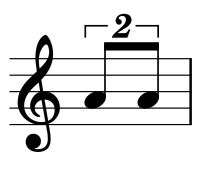 | 2 | 3 notes | Compound |
| Triplet | 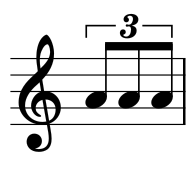 | 3 | 2 notes | Simple |
| Quadruplet | 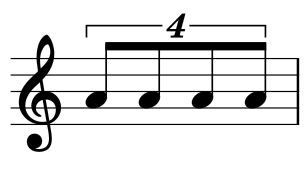 | 4 | 6 notes (see the note below) | Compound |
| Quintuplet | 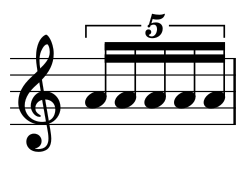 | 5 | 4 or 6 notes | Depends on context |
| Sextuplet | 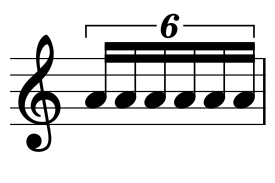 | 6 | 4 notes | Simple |
| Septuplet | 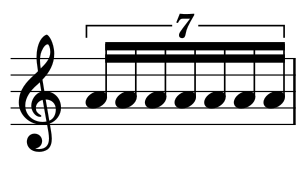 | 7 | 6 or 8 notes | Depends on context |
Larger groups exist (eight, nine and so on) but they are rare.
The "usual meter" column shows only where each tuplet appears most often. It is not a strict rule. What makes a tuplet "irregular" is the normal division of the meter: in simple meters the beat divides into two, so the typical tuplet is the triplet. In compound meters the beat divides into three, so the typical ones are the duplet and the quadruplet. But any tuplet can appear in any meter: a sixteenth-note triplet, for example, is perfectly normal inside 6/8. What matters is not the meter itself but the value that the group subdivides.
The triplet
The triplet is by far the most used tuplet. It is three equal notes played in the time that two would normally take. It is typical of simple meters, whose natural subdivision is binary: it brings a ternary division where a binary one is expected. It can also appear in a compound meter whenever it subdivides a value that would normally divide into two.
A triplet can be made from any note value: an eighth-note triplet (the most common, it takes one quarter note), a quarter-note triplet (it takes a half note, two beats), a sixteenth-note triplet (it takes one eighth note), and so on. In every case, the three notes share equally the value of two notes of the same kind.
The duplet
The duplet is, in a way, the triplet "in reverse": two equal notes played in the time that three would normally take. That is why it is typical of compound meters (6/8, 9/8, 12/8...), where each beat divides naturally into three parts. The duplet brings a binary division into a ternary setting. It appears wherever a ternary value is subdivided, whatever the meter.
Quadruplet, quintuplet, sextuplet and septuplet
The larger the number, the rarer the group, but all follow the same logic: the number says how many notes share a space that would hold a different number of notes.
- Quadruplet (4): in the Spanish-language tradition, four notes in the place of six, which is equivalent to a duplet with each note subdivided. Typical of compound meters. Many English-language sources instead define a quadruplet as four notes in the time of three (4:3), so when in doubt look for a written ratio.
- Quintuplet (5): five notes in the place of four or of six, depending on whether it subdivides a binary or a ternary value.
- Sextuplet (6): six notes in the place of four. It should not be confused with two triplets in a row: a sextuplet feels like a single group.
- Septuplet (7): seven notes in the place of six or of eight, depending on the value it fills.
Here is the delicate part: when the number of the group falls between two regular numbers, its equivalence is no longer unique. The quintuplet (5) sits between 4 and 6, and the septuplet (7) between 6 and 8. Depending on whether they fill a binary or a ternary value, they equal one or the other, and the context decides. When there is a risk of ambiguity, the full ratio is written, for example 5:4 versus 5:6, to make clear how many notes the group replaces. The quadruplet (4) and the sextuplet (6) are treated as having a fixed equivalence in the Spanish-language tradition: 6 and 4, respectively. This site follows the Spanish-language tradition: a quadruplet is four notes in the place of six. Be aware that another definition also exists: outside that tradition, and especially in English-language sources, a quadruplet is four notes in the place of three (4:3), that is, a surplus group; this is the reading attributed to H. Riemann. If you are unsure in front of a score, look for the written ratio, because it rules.
How to work out their duration
The rule is always the same: the tuplet lasts as long as the number of notes it replaces, and that time is shared equally among its notes. The question is how many it replaces. That regular number is the normal subdivision of the value the group fills. If that value divides in a binary way, the group is measured against a power of two (2, 4, 8...). If it divides in a ternary way, it is measured against a multiple of three (3, 6...). For the triplet, duplet, quadruplet and sextuplet the reference is fixed. For the quintuplet and septuplet, as we have seen, the context sets it.
| Tuplet | Fills the time of | Each note lasts (in quarter notes) |
|---|---|---|
| Eighth-note triplet | 2 eighth notes = 1 quarter note | ⅓ of a quarter note |
| Quarter-note triplet | 2 quarter notes = 1 half note | ⅔ of a quarter note |
| Eighth-note duplet | 3 eighth notes = 1 dotted quarter note | ¾ of a quarter note |
| Sixteenth-note quintuplet | 4 sixteenth notes = 1 quarter note | ⅕ of a quarter note |
In practice, you do not need to think in fractions to play a triplet: just divide the beat into three equal parts instead of two. Practicing with a metronome helps you absorb the feel of the group inside the beat.
Do not confuse tuplets with dots or ties
Tuplets change how many notes fit in a beat. They should not be confused with other devices that also affect duration:
- The dot lengthens a single note by half of its value.
- The tie adds together the durations of two notes of the same pitch.
To practice how many notes each group replaces, with triplets, duplets, quadruplets and sextuplets, see the tuplet exercises, with three levels and a PDF worksheet. To go further, What time signature is it? gives a whole measure full of irregular groups and you have to work out the time signature by simplifying.