
The two numbers at the start of a measure (UK: bar) are not a fraction. They tell you how many parts the measure has and which note value fills each one. To understand them, you need two ideas: the measure unit and the beat unit.
Measure unit
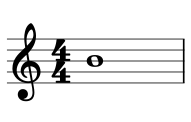
The measure unit is the note value (or sum of note values) that fills one whole measure. In 4/4 the measure unit is the whole note (UK: semibreve), because a whole note lasts exactly four beats. (In English this term is less common than in Spanish-language theory, but the idea is useful.)
Beat unit
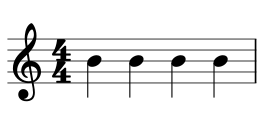
The beat unit is the note value that represents one beat, the pulse you tap with your foot or hear on the metronome. In 4/4 the beat unit is the quarter note (UK: crotchet): the measure holds four quarter notes, one per beat.
How to read the time signature numbers
In simple meters (the most common), the two numbers are read like this:
- The top number tells you how many beats are in each measure.
- The bottom number tells you which note value is the beat unit: 2 = half note, 4 = quarter note, 8 = eighth note.
| Time signature | Beats | Beat unit | Measure unit |
|---|---|---|---|
| 2/4 | 2 | Quarter note | Half note |
| 3/4 | 3 | Quarter note | Dotted half note |
| 4/4 | 4 | Quarter note | Whole note |
| 2/2 | 2 | Half note | Whole note |
| 3/8 | 3 | Eighth note | Dotted quarter note |
Subdivision
The subdivision is the number of parts each beat is divided into. This is where the two main kinds of meter differ:
- In simple meters, each beat divides into two (a quarter note into two eighth notes). The beat unit is an undotted note.
- In compound meters, each beat divides into three. The beat unit is a dotted note.
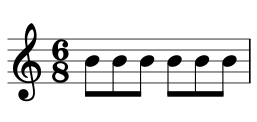
That is why the numbers of a compound meter such as 6/8 are read differently. The 8 does not give the beat. It gives the subdivision (the eighth note). The six eighth notes are grouped in threes, forming two beats of dotted quarter note:
To find the beats and accents of any time signature, see how to analyze time signatures and rhythmic accents.