
3/4 time is a simple meter with three quarter-note (UK: crotchet) beats per measure (UK: bar). It is the meter of the waltz and, in general, of music with a characteristic triple "one-two-three" pulse.
What does 3/4 mean?
In the time signature, the top number 3 says the measure has three beats and the bottom number 4 says the note value that gets one beat is the quarter note. Because it is a simple meter, each of the three beats divides into two eighth notes (UK: quavers), and the accent pattern is Strong–Weak–Weak.
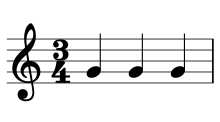
How to count 3/4
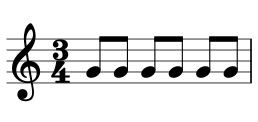
Count "1 – 2 – 3", with a strong accent on the first beat and two weak ones after it. This is the typical sway of a waltz: one marked accent followed by two lighter pulses. Each beat divides into two eighth notes, giving six eighth notes per measure grouped 2+2+2:
3/4 at a glance
| Element | In 3/4 |
|---|---|
| Type of meter | Simple (triple) |
| Beats per measure | 3 |
| Beat unit | Quarter note |
| Subdivision of each beat | 2 eighth notes (binary) |
| Eighth notes per measure | 6 (grouped 2+2+2) |
| Accent pattern | Strong – Weak – Weak |
Example melody in 3/4
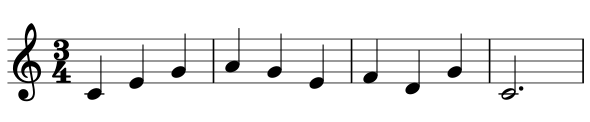
This melody in C major shows the triple sway of the waltz. The last measure ends on a dotted half note, which fills all three beats:
Where is 3/4 used?
- Waltz: 3/4 is the waltz meter par excellence, with its "oom-pah-pah."
- Minuet and mazurka: classical and folk triple-meter dances.
- Ballads and songs: many gentle, swaying songs are in 3/4.
3/4 compared with 6/8: the most common confusion
3/4 and 6/8 both contain six eighth notes, but they are grouped differently: 3/4 has three beats with a binary subdivision (2+2+2), while 6/8 has two beats with a ternary subdivision (3+3). That is why 3/4 gives a clear triple pulse (the waltz) and 6/8 sounds rocking. Its compound counterpart is 9/8, which has the same three beats but divides each one in three.
To check whether you can tell them apart by ear, try the listening exercise recognize the meter by ear. Pay attention to how the eighth notes group: 2+2+2 is 3/4, 3+3 is 6/8.
How to practice 3/4
Practice the waltz sway with the online metronome with 3/4 already selected: the accent on the first beat marks the "one" of each measure. To identify the time signature of a score, use the time signature analyzer.