
9/8 time is a compound meter with three beats. Although nine eighth notes (UK: quavers) fit in a measure (UK: bar), they group in threes to form three pulses, each equal to a dotted quarter note (UK: dotted crotchet). It is the compound triple meter, the "twin" of 3/4.
What does 9/8 mean?
In the time signature, the top number 9 says how many eighth notes fit in the measure, and the bottom number 8 says the reference note value is the eighth note. But those nine eighth notes are not nine beats: they group into three sets of three, so 9/8 is counted in three.
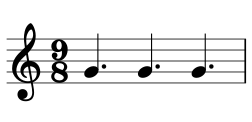
How to count 9/8
Each of the three beats divides into three eighth notes (ternary subdivision). Count "1 2 3 – 4 5 6 – 7 8 9", leaning on the eighth notes 1, 4 and 7. The first is strong and the other two are weak (strong–weak–weak):
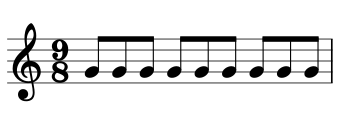
9/8 at a glance
| Element | In 9/8 |
|---|---|
| Type of meter | Compound (triple) |
| Beats per measure | 3 |
| Beat unit | Dotted quarter note |
| Subdivision of each beat | 3 eighth notes (ternary) |
| Eighth notes per measure | 9 (grouped 3+3+3) |
| Accent pattern | Strong – Weak – Weak |
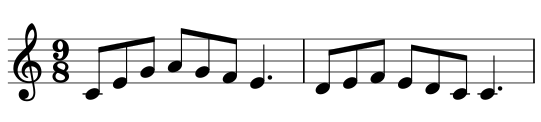
Example melody in 9/8
This melody in C major shows the ternary flow of 9/8. Each beat is either a group of three eighth notes or a dotted quarter note:
Where is 9/8 used?
- Baroque music: common in gigues and in movements of a pastoral character.
- Folk music: it appears in traditional dances of many cultures.
- Contemporary music: progressive rock and jazz use it for its broad ternary sway.
9/8 compared with 3/4
9/8 is the compound twin of 3/4: both have three beats with the same accent pattern (strong–weak–weak). The difference is the subdivision: in 3/4 each beat divides in two (it is a quarter note), and in 9/8 it divides in three (it is a dotted quarter note). You can see the full accent hierarchy on the page about accents in compound meters.
To practice the difference by ear, try the listening exercise recognize the meter by ear: 9/8 and 3/4 have the same three beats, but the beat in 9/8 divides in three.
How to practice 9/8
Practice the three ternary beats with the online metronome with 9/8 already selected: you will hear the accent on the first beat of each group of three. To identify the time signature of a score, use the time signature analyzer.