
3/8 time is a simple meter with three beats in which the note value that gets one beat is the eighth note (UK: quaver). It is the main source of confusion between simple and compound meters: because of the 8 in the bottom number, many people assume it is compound. It is not.
What does 3/8 mean?
In the time signature, the top number 3 says there are three beats and the bottom number 8 says each beat is an eighth note (one eighth of a whole note). Each beat divides into two sixteenth notes (UK: semiquavers), so 3/8 is a simple meter, exactly like 3/4 or any other three-beat meter, but with the eighth note as the beat unit instead of the quarter note.
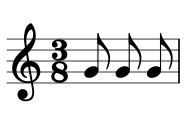
Is 3/8 simple or compound?
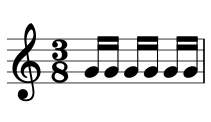
It is simple. The rule is clear: a meter is compound only when its top number is 6, 9 or 12 (beats that divide into three). With a top number of 3, the meter is simple even if the bottom number is 8. Each of its three eighth notes divides into two sixteenth notes:
3/8 at a glance
| Element | In 3/8 |
|---|---|
| Type of meter | Simple (triple) |
| Beats per measure | 3 |
| Beat unit | Eighth note |
| Subdivision of each beat | 2 sixteenth notes (binary) |
| Eighth notes per measure | 3 |
| Accent pattern | Strong – Weak – Weak |
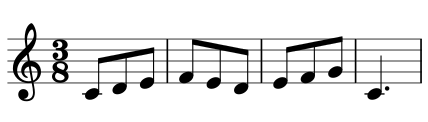
Example melody in 3/8
At a fast tempo, the three eighth notes of 3/8 are often felt as a single pulse per measure, which gives a light, spinning character. The last measure ends on a dotted quarter note, which fills all three beats:
Where is 3/8 used?
- Scherzos and fast movements: a quick 3/8 is felt in one, which suits agile passages.
- Lively dances: light triple-meter dances at a fast tempo.
How to practice 3/8
Start by counting the three beats separately on the online metronome with 3/8 already selected. When that feels comfortable, raise the tempo until you feel each measure as a single impulse. To check the time signature of a score, use the time signature analyzer.