
Cut time, also called alla breve, is a simple meter with two half-note (UK: minim) beats per measure (UK: bar), equal to 2/2. It is written with the symbol ¢ (a C with a vertical line through it), and it means counting "in two" what would otherwise be written in four beats. In Spanish it is called compás partido, "split time."
What is cut time?
Cut time is the same as the time signature 2/2: two beats per measure, each worth a half note. The name comes from the symbol: common time (the C that stands for 4/4) is "cut" by a vertical line, which halves the number of beats: instead of four quarter-note beats you count two half-note beats.
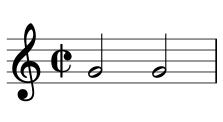
How to count cut time
Count "1 – 2", leaning on the 1. Each half note divides into two quarter notes (UK: crotchets), so the four quarter notes of the measure group 2+2. The point of alla breve is exactly this: although there are four quarter notes, you feel two pulses, not four, which lightens the music at fast tempos.
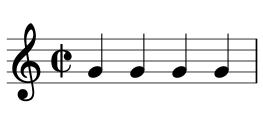
Cut time (2/2) at a glance
| Element | In cut time (¢) |
|---|---|
| Symbol | ¢ (cut C) |
| Equivalent time signature | 2/2 |
| Type of meter | Simple (duple) |
| Beats per measure | 2 |
| Beat unit | Half note |
| Subdivision of each beat | 2 quarter notes (binary) |
| Accent pattern | Strong – Weak |
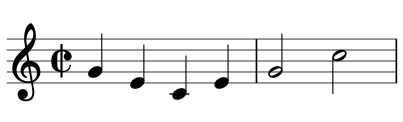
Example melody in cut time
This melody in C major is felt "in two" even though the first measure has four quarter notes. That is the light character of alla breve:
Cut time (¢) compared with common time (C)
This is the most frequent confusion between the two symbols inherited from old notation:
| Symbol | Means | Beats | Beat unit |
|---|---|---|---|
| C (common time) | 4/4 | 4 | Quarter note |
| ¢ (cut time) | 2/2 | 2 | Half note |
Both meters hold the same total length (one whole note), but common time is felt in four and cut time in two. You can see both symbols in context in the time signature analyzer.
Where is cut time used?
- Fast marches: alla breve gives the brisk pulse of a lively march.
- Early and Baroque music: common in fast movements and fugues.
- Overtures and finales: counting in two conveys lightness and speed.
How to practice cut time
Practice the half-note pulse with a steady click on the online metronome, and check the time signature of a score with the time signature analyzer.