
2/4 time is a simple meter with two beats: each measure (UK: bar) holds two quarter notes (UK: crotchets), and each beat divides into two equal parts (duple subdivision). It is one of the most basic meters and the meter of the march, the polka and the pasodoble.
What does 2/4 mean?
In the time signature, the top number 2 says the measure has two beats, and the bottom number 4 says that the note value that gets one beat is the quarter note (one fourth of a whole note). Because 2/4 is a simple meter, each of the two beats divides in two. The strong accent falls on beat 1 and the weak one on beat 2 (strong–weak).
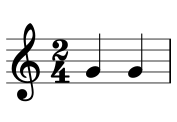
How to count 2/4
Count simply "1 – 2", leaning on the 1. Each beat can be divided into two eighth notes (UK: quavers), which gives the familiar "one-two, one-two" feel of a march:
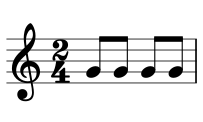
2/4 at a glance
| Element | In 2/4 |
|---|---|
| Type of meter | Simple (duple) |
| Beats per measure | 2 |
| Beat unit | Quarter note |
| Subdivision of each beat | 2 eighth notes (binary) |
| Notes that fill a measure | 2 quarter notes, 1 half note, 4 eighth notes… |
| Accent pattern | Strong – Weak |
Example melody in 2/4
This melody in C major shows the marked, symmetrical character of 2/4. The last measure ends on a half note, which fills both beats:
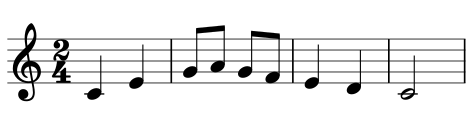
Where is 2/4 used?
- Marches: the "left-right" duple pulse of marching is 2/4 by nature.
- Polka: a fast, bouncy Central European dance.
- Pasodoble: the typical meter of Spanish bullfighting and band music.
- Folk and popular music: many traditional songs and dance styles.
2/4 compared with 6/8 and 4/4
2/4 and 6/8 are both counted in two, but 2/4 has a binary subdivision (each beat in two) and 6/8 a ternary one (each beat in three). That is why 6/8 sounds rocking and 2/4 sounds square and marked. Compared with 4/4, 2/4 is lighter, with only two beats instead of four, which gives it its continuous "oom-pah" character.
To learn to tell them apart by ear, try the listening exercise recognize the meter by ear: a melody plays with the first beat accented and you decide whether it is in 2/4, 4/4, 6/8 or another meter.
How to practice 2/4
Practice the duple pulse with a steady click on the online metronome with 2/4 already selected: the accent on the first beat helps you feel the "1-2" without getting lost. To identify the time signature of a score, use the time signature analyzer.