
4/4 time is a simple meter with four quarter-note (UK: crotchet) beats per measure (UK: bar). It is by far the most used meter in Western music, so much so that it is also called common time and written with the symbol C.
What does 4/4 mean?
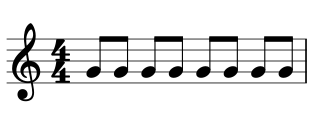
In the time signature, the top 4 says the measure has four beats and the bottom 4 says the note value that gets one beat is the quarter note. Because it is a simple meter, each of the four beats divides into two equal parts (two eighth notes, UK: quavers).
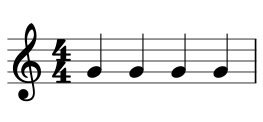
How to count 4/4
Count "1 – 2 – 3 – 4", with the accent pattern Strong – Weak – Medium – Weak: the main accent falls on beat 1 and a secondary accent on beat 3. Each beat can be divided into two eighth notes, giving eight eighth notes per measure:
The C symbol: common time
4/4 is so common that it has its own symbol, inherited from old notation: the letter C, called common time. When that C is crossed by a vertical line (¢), it is no longer 4/4 but cut time (2/2, also called alla breve). You can see both symbols in context in the time signature analyzer.
4/4 at a glance
| Element | In 4/4 |
|---|---|
| Equivalent symbol | C (common time) |
| Type of meter | Simple (quadruple) |
| Beats per measure | 4 |
| Beat unit | Quarter note |
| Subdivision of each beat | 2 eighth notes (binary) |
| Accent pattern | Strong – Weak – Medium – Weak |
Example melody in 4/4
This melody in C major shows the balance of 4/4. The last measure ends on a whole note (UK: semibreve), which fills all four beats:

Where is 4/4 used?
- Pop, rock and electronic music: the vast majority of modern songs are in 4/4.
- Classical music: found in every genre, from the symphony to the sonata.
- Marches and band music: the quadruple pulse supports much of the repertoire.
4/4 compared with 2/4 and 12/8
Compared with 2/4, 4/4 has twice as many beats: it allows longer phrases and a secondary accent on beat 3. Compared with 12/8, its "compound twin," both have four beats with the same accent pattern, but 4/4 divides each beat in two and 12/8 divides it in three.
To practice this difference by ear, try the listening exercise recognize the meter by ear: count the beats from one accent to the next (4/4 versus 2/4) and notice whether each beat divides in two or in three (4/4 versus 12/8).
How to practice 4/4
Practice the four beats with the online metronome with 4/4 already selected: you will hear the accent on the first beat of each measure. To identify the time signature of a score, use the time signature analyzer.