
The 12/8 time signature is a compound meter with four beats: the twelve eighth notes (UK: quavers) are grouped in threes to make four pulses, each equal to a dotted quarter note (UK: dotted crotchet). It is the meter of slow blues, ballads and the shuffle feel.
What is 12/8?
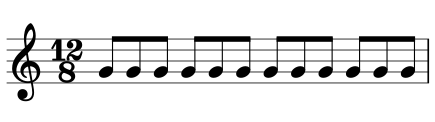
In the time signature, the 12 says how many eighth notes fit in the measure (UK: bar), and the 8 says that the reference note value is the eighth note. Those twelve eighth notes are grouped into four groups of three, so 12/8 is counted in 4.
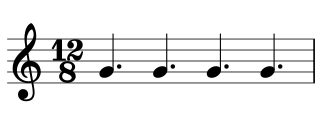
How to count 12/8
Each of the four beats divides into three eighth notes (triple subdivision). The pulses fall on eighth notes 1, 4, 7 and 10, with the accent pattern strong – weak – medium-strong – weak, the same as 4/4 but with each beat divided into three:
12/8 at a glance
| Element | In 12/8 |
|---|---|
| Type of meter | Compound |
| Number of beats | 4 |
| Beat unit (pulse) | Dotted quarter note |
| Subdivision of each beat | 3 eighth notes (triple) |
| Eighth notes per measure | 12 (grouped 3+3+3+3) |
| Accent pattern | Strong – Weak – Medium-strong – Weak |
Example melody in 12/8
This melody in C major shows the continuous triple rocking of 12/8, with four groups of three eighth notes in each measure:

Where is 12/8 used?
- Slow blues: the triple-feel shuffle of classic blues is often written in 12/8.
- Ballads: slow rock and soul use 12/8 for its continuous rocking feel.
- Doo-wop: the triplet accompaniment of the 1950s is pure 12/8.
- Baroque music: common in slow, pastoral movements such as the siciliana.
12/8 compared with 4/4
12/8 is the compound twin of 4/4: both have four beats with the same accent pattern (S-W-M-W). The difference is the subdivision: 4/4 divides each beat in two and 12/8 divides it in three. That is why a ballad in 12/8 "rocks" with its continuous triplet feel, while in 4/4 the pulse is straighter. More details in accents in compound meters.
To practice telling them apart by ear, try the ear-training exercise recognize the meter by ear: the accent comes back every four beats in both meters, and only the way each beat divides is different.
How to practice 12/8
Practice the four triple pulses with the online metronome with 12/8 already selected. To identify the time signature of a score, use the guide to analyzing time signatures.