
3/2 time is a simple meter with three beats in which the note value that gets one beat is the half note (UK: minim). It is like a 3/4 "written large": three beats, but with the half note as the unit instead of the quarter note. It is common in early music.
What does 3/2 mean?
In the time signature, the top number 3 says there are three beats and the bottom number 2 says each beat is a half note (half of a whole note). Each half note divides into two quarter notes (UK: crotchets), so 3/2 is a simple meter with the accent pattern Strong–Weak–Weak.
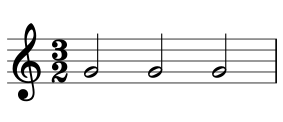
How to count 3/2
Count "1 – 2 – 3", leaning on the 1. Each beat (half note) divides into two quarter notes, which gives six quarter notes per measure grouped 2+2+2:
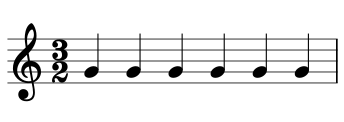
3/2 at a glance
| Element | In 3/2 |
|---|---|
| Type of meter | Simple (triple) |
| Beats per measure | 3 |
| Beat unit | Half note |
| Subdivision of each beat | 2 quarter notes (binary) |
| Quarter notes per measure | 6 (grouped 2+2+2) |
| Accent pattern | Strong – Weak – Weak |
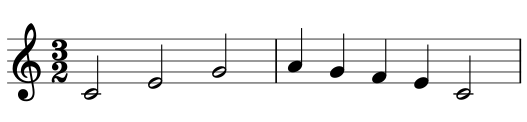
Example melody in 3/2
This melody in C major shows the broad, unhurried character of 3/2, with its three opening half notes:
Where is 3/2 used?
- Renaissance music: 3/2 is one of the characteristic meters of Renaissance vocal polyphony.
- Baroque music: common in sarabandes and in slow movements of a solemn character.
3/2 compared with 3/4
3/2 and 3/4 have the same three beats and the same accent pattern (strong–weak–weak). Only the note value that gets one beat changes: the half note in 3/2 and the quarter note in 3/4. Writing in 3/2 gives a broader, more spacious look on the page, typical of early music.
Do not confuse 3/2 with 6/4: both hold six quarter notes, but 3/2 groups them 2+2+2 (three simple beats) and 6/4 groups them 3+3 (two compound beats). Moving briefly from one grouping to the other is called a hemiola, a device common in Baroque music and in Spanish folk music.
How to practice 3/2
Practice the three beats with a steady pulse on the online metronome, and check the time signature of a score with the time signature analyzer.