
6/4 time is a compound meter with two beats: the six quarter notes (UK: crotchets) group in threes to form two pulses, each equal to a dotted half note (UK: dotted minim). It is the "big brother" of 6/8: the same structure, but with the quarter note as the subdivision instead of the eighth note.
What does 6/4 mean?
In the time signature, the top number 6 says that six quarter notes fit in the measure (UK: bar) and the bottom number 4 says the reference note value is the quarter note. Those six quarter notes group into two sets of three, so 6/4 is normally counted in two (although at very slow tempos it can be felt in six).
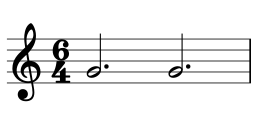
How to count 6/4
Each of the two beats divides into three quarter notes (ternary subdivision). The six quarter notes group 3+3, with the strong accent on the first note of each group:
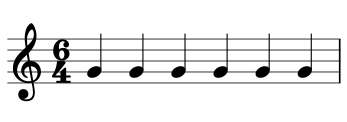
6/4 at a glance
| Element | In 6/4 |
|---|---|
| Type of meter | Compound (duple) |
| Beats per measure | 2 |
| Beat unit | Dotted half note |
| Subdivision of each beat | 3 quarter notes (ternary) |
| Quarter notes per measure | 6 (grouped 3+3) |
| Accent pattern | Strong – Weak |
Example melody in 6/4
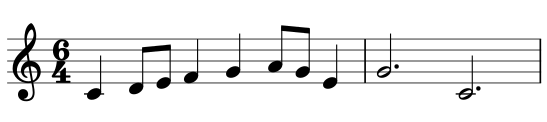
This melody in C major shows the broad character of 6/4. It ends with two dotted half notes, one for each beat:
Where is 6/4 used?
- Renaissance and Baroque music: frequent in broad passages of a solemn character.
- Modern music: it appears in passages that look for a wide, swaying triple feel.
6/4 compared with 6/8 and 3/2
6/4 and 6/8 have the same structure: two compound beats grouped 3+3. Only the beat unit changes (a dotted half note in 6/4, a dotted quarter note in 6/8). 3/2, on the other hand, also holds six quarter notes, but grouped 2+2+2 (three simple beats), not 3+3.
6/4 and the hemiola (3 against 2)
The fact that 6/4 and 3/2 hold the same six quarter notes, grouped 3+3 in one and 2+2+2 in the other, is the basis of an important rhythmic device, the hemiola (from the Greek hēmiólios, "one and a half," the 3:2 ratio).
A hemiola happens when, within a measure of 6/4 (or across two measures of 3/4), the music re-accents the six quarter notes as three groups of two instead of two groups of three. For a moment the ear moves from feeling "two" (6/4) to feeling "three" (3/2), without any change in the time signature:
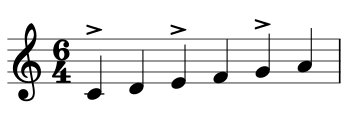
The hemiola is typical of Baroque cadences (Bach and Handel use it constantly before the final chord), of the French courante, and of Spanish and Latin American music: the 6/8 ↔ 3/4 sway of the jota, the guajira or the huapango, known in Spanish tradition as the sesquialtera, is the same game of 3 against 2.
How to practice 6/4
Practice the two ternary beats with a steady pulse on the online metronome, and check the time signature of a score with the time signature analyzer.