
The clarinet is the single-reed woodwind of the orchestra and the classic transposing instrument. The usual clarinet is pitched in B♭ and sounds a whole step (UK: tone) below the written note. This page gives its notes, its four registers (chalumeau, throat, clarion and altissimo) and what makes the clarinet different from the flute, oboe and bassoon: it overblows at the 12th, not at the octave.


| Family | Woodwind (single reed) |
|---|---|
| Pitch | B♭ (the A clarinet is also common in orchestras) |
| Transposition | Yes: sounds a whole step below written |
| Range | Written E3–A6 (sounding D3–G6) |
| Mechanism | Keys (Boehm system) |
| Clef | Treble |
Does the clarinet transpose? What does "in B♭" mean?
Yes. When a clarinetist reads and fingers a C, a B♭ sounds: the instrument sounds a whole step below the written note, and that is why it is called a clarinet "in B♭". To sound the same pitch as a piano, the part is written a whole step higher. It is always read in treble clef. Orchestras also use the clarinet in A, which sounds a minor 3rd below the written note. This page is about the B♭ clarinet, the one used in bands, schools and conservatories. All the notes below are written notes unless it says "sounding".
| Written note | Sounding note |
|---|---|
| C | B♭ |
| D | C |
| E | D |
| F | E♭ |
| G | F |
| A | G |
| B | A |
The rule is always the same: what is written sounds a whole step lower. To write for the clarinet, you transpose the sounding music up a whole step, which adds two sharps (or removes two flats) in the key signature.
Range and registers: chalumeau, throat, clarion and altissimo
The standard range runs from the written E3 (sounding D3) to the written A6: more than three octaves, one of the widest of the woodwinds. Its registers are so distinctive that they have names of their own:
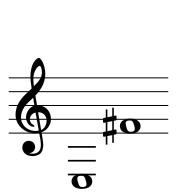
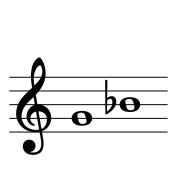
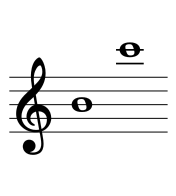
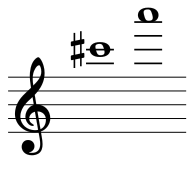
| Register | Notes (written) | Character |
|---|---|---|
| Chalumeau | E3–F♯4 | Low, dark and velvety |
| Throat | G4–B♭4 | Pale, the awkward "bridge" |
| Clarion | B4–C6 | Bright and singing, the most used |
| Altissimo | C♯6–A6 | Piercing, close to the piccolo |
Pitches use scientific pitch notation (C4 is middle C). Advanced players go above the written A6 with special fingerings.
How many notes does the clarinet have?
There are only seven note names, but counting the accidentals the clarinet produces 42 different pitches in its standard range (written E3–A6). Compared with the other woodwinds:
| Instrument | Range |
|---|---|
| B♭ clarinet | E3–A6 written (sounds a whole step lower) |
| Bassoon | B♭1–E♭5 |
| Oboe | B♭3–G6 |
| Flute | C4–C7 |
The register key: the clarinet overblows at the 12th, not the octave
This is the big secret of the clarinet. On the flute, the oboe or the bassoon, overblowing repeats a fingering an octave higher. The clarinet does not. Its bore is cylindrical and behaves like a closed tube, so it favors only the odd harmonics, and when you press the register key the note jumps a 12th (an octave plus a perfect 5th) instead of an octave. That is why the thumb key is called the register key and not an "octave key", why there are extra notes in between (the throat tones) and why the range is so wide:
| Same fingering… | …without register key | …with register key (a 12th higher) |
|---|---|---|
| Thumb + holes 1·2·3·4·5·6 | G3 | D5 |
| Thumb + holes 1·2·3 | C4 | G5 |
| Thumb + holes 1·2 | D4 | A5 |
The lowest written note, E3, with the register key added, becomes B4.
Clarinet fingerings (Boehm system)
The modern conservatory clarinet uses the Boehm system: 17 keys and 6 rings, with six finger holes (1–3 for the left hand, 4–6 for the right), two throat keys (A and G♯), the little-finger clusters of each hand and, on the back, the left thumb hole and the register key. Each note is a specific combination of these, and the same pattern repeats a 12th higher with the register key.
Choose a note and you will see its fingering, the note on the staff and a real clarinet sound (the real pitch, a whole step below written).
The clarinet family
The B♭ clarinet is only the middle sibling. Above it is the E♭ clarinet (smaller and shriller). Below it come the alto clarinet (in E♭), the bass clarinet (in B♭, an octave below the B♭ clarinet) and the contrabass clarinet. They all read in treble clef with the same fingerings, which is the big advantage of the family: a clarinetist can switch from one to another reading the same way, because the instrument "absorbs" the transposition. For all of them at a glance, see the complete clarinet family.
Common mistakes when learning clarinet notes
- Mishandling the thumb. The thumb hole is covered for the notes of the chalumeau register and the register key is added for the clarion register. Check the chart each time you change register.
- Getting stuck at the "break". Crossing from the throat register (B♭4) to the clarion register (B4) means moving from almost nothing pressed to almost everything pressed at once. It is the most feared jump, and it is practiced slowly.
- Not sealing the holes. The holes are surrounded by rings: if a finger does not seal completely, the note squeaks or jumps up to the next harmonic.
- Mixing up written and sounding notes. If you play with a piano, your written C is its B♭: to sound in unison you must read a whole step higher (or use a part that is already transposed).
Summary
- The usual clarinet is in B♭: it transposes and sounds a whole step below the written note. It reads in treble clef.
- Written range E3–A6: about 42 pitches, one of the widest of the woodwinds.
- The registers have names: chalumeau, throat, clarion and altissimo.
- It overblows at the 12th (the register key, not an octave key) because its cylindrical bore behaves like a closed tube.
- It uses the Boehm system with 17 keys and 6 rings.