
The oboe is the soprano of the double-reed family among the woodwinds. It is pitched in C and does not transpose, and it is the instrument that gives the tuning A to the whole orchestra. Below you will find its range register by register, how the sound is made and how its keywork is organized.


| Family | Woodwind (double reed) |
|---|---|
| Pitch | C |
| Transposition | None: it sounds as written |
| Range | B♭3–G6 |
| Mechanism | Keys (Conservatoire system) |
| Clef | Treble |
Does the oboe transpose?
No. The oboe is a C instrument and non-transposing: the note you read on the score is exactly the one that sounds. It always reads in treble clef. Because its pitch is steady and its tone is penetrating, the oboe plays the A4 to which the orchestra tunes before the concert.
Range and registers
The range of the oboe runs from the low B♭3 to the high G6. Some sources using the Franco-Belgian octave numbering (where middle C is C3) give it as B♭2–G5. It is divided into four registers:
| Register | Range | On the staff | Character |
|---|---|---|---|
| Low | B♭3 – G4 | 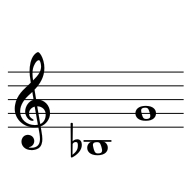 | Thick and intense, with the reed very present; hard to play softly. |
| Middle | G4 – G5 | 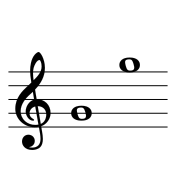 | The most characteristic and expressive: this is where the oboe sings. |
| High | G5 – D6 | 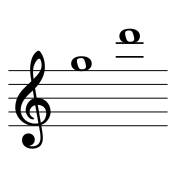 | Thinner and clearer; it loses body as it rises. |
| Very high | D6 – G6 | 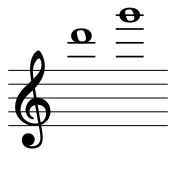 | Tense and thin, hard to tune; rarely used. |
Octaves are in scientific pitch notation (C4 is middle C). In practice, advanced oboists go above G6, although those "altissimo" notes are risky.
How many notes does the oboe have?
As on any instrument there are seven note names (C, D, E, F, G, A and B), but the oboe produces about 34 different pitches counting accidentals, from B♭3 to G6: the same seven names repeat octave after octave over a range of a little less than three octaves.
How the sound is made: the double reed
The oboe has no mouthpiece with a single reed like the clarinet or the saxophone. It sounds with a double reed: two thin blades of cane tied together, which the player makes vibrate against each other by blowing between them. It is the same principle as its low relative, the bassoon. The double reed gives the oboe its nasal, penetrating and expressive tone, able to cut through the sound of the whole orchestra. Controlling the air and the lips on the reed is the most demanding part of the instrument.
The key system
The modern oboe uses the Conservatoire system (also called the French system), a mechanism of keys and plates that covers the tone holes and allows logical fingering and steady intonation across the whole range. Its alto relative, the English horn, uses the same system with identical fingerings (it sounds a perfect 5th lower than written). As on other woodwinds, the move into the high register is made with the octave keys, which open a small vent so that the tube sounds the next harmonic.
Oboe fingerings
Each note comes from a specific combination of keys and plates. The oboe has six main tone holes (1–3 for the left hand, 4–6 for the right), the octave keys, a fork F key between holes 5 and 6 and the little-finger clusters of each hand. A "half hole" is not a separate key but the first hole covered only halfway.
The diagram covers the oboe fingerings from B♭3 to G6: choose a note and you will see its fingering, the note on the staff and a real oboe sound.
Common mistakes when learning oboe notes
- Biting or squeezing the reed. Intonation and tone depend on a steady, relaxed embouchure, not on lip pressure.
- Forgetting the octave keys. Many notes in the middle and high registers share their fingering with lower notes and only change when the right octave key is added.
- Blowing harder to go higher. The high register comes from faster, supported air and the right octave key, not from more pressure.
- Neglecting the little fingers. The little-finger key clusters (the lowest notes and several accidentals) are hard at first; look carefully at the fingering chart.
In short
- The oboe is pitched in C and does not transpose; it gives the tuning A to the orchestra.
- Its range runs from B♭3 to G6 (four registers), about 34 pitches.
- It sounds with a double reed, which explains its penetrating tone.
- It uses the Conservatoire key system, with octave keys for the high register.