
The English horn (UK: cor anglais) is the alto of the oboe family: longer than the oboe, with a curved bocal, a pear-shaped bell (the piriform bell) and an unmistakable melancholy voice. It is pitched in F, so it sounds a perfect 5th below the written note, and it is fingered exactly like the oboe. This page gives its notes, its registers and what it shares with the oboe.


| Family | Woodwind (double reed) |
|---|---|
| Pitch | F |
| Transposition | Yes: sounds a perfect 5th below written |
| Range | Written B3–G6 (sounding E3–C6) |
| Mechanism | Keys (fingered like the oboe) |
| Clef | Treble |
| Also called | Cor anglais, tenor oboe |
Does the English horn transpose? What does "in F" mean?
Yes: it transposes by a perfect 5th. When the player reads and fingers a C, the F a perfect 5th below sounds. It is written this way so that an oboist can switch instruments using the same fingerings: the same fingering that gives a written C on the oboe gives a written C here, although the longer tube turns it into a sounding F. It is always read in treble clef. All the notes below are written notes unless it says "sounding".
| Written note | Sounding note |
|---|---|
| C | F (a 5th down) |
| D | G |
| E | A |
| F | B♭ |
| G | C |
| A | D |
| B | E |
Range and registers
The written range runs from B3 to G6; in sounding pitch, from E3 to C6. Note one detail: unlike the oboe, a standard English horn has no low B♭ key, so its lowest written note is B natural (some modern instruments add a low B♭ key). Its registers (written) are:
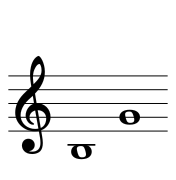
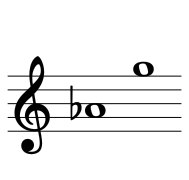
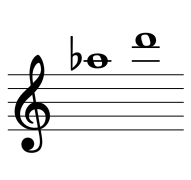
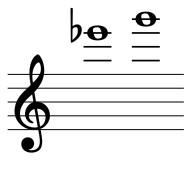
Pitches use scientific pitch notation (C4 is middle C). In orchestral practice the English horn lives mostly in its low and middle registers, where its tone is most characteristic; the extreme top of the written range rarely appears. Counting the accidentals it produces 33 different pitches in its standard range. Its most famous solos lie there: the Largo of Dvořák's New World Symphony, Sibelius's The Swan of Tuonela (a whole piece built around its voice) and the ranz des vaches in the overture to Rossini's William Tell.
Is the English horn played like the oboe?
Yes: it uses the Conservatoire system with the same fingerings, which is why in the orchestra an oboist plays it (it is the natural double, like the piccolo for the flutist). The differences are physical: it is longer, the reed (also larger than the oboe's) sits on a curved metal bocal instead of going directly into the body, the bell is piriform (pear-shaped), which contributes to its veiled, velvety sound, and a standard instrument lacks the low B♭ key. Compared with the other woodwinds:
| Instrument | Range |
|---|---|
| English horn | B3–G6 written (sounds a perfect 5th lower) |
| Oboe | B♭3–G6 |
| B♭ clarinet | E3–A6 written (sounds a whole step lower) |
| Bassoon | B♭1–E♭5 |
English horn fingerings
The English horn is an oboe in F: it has the same Conservatoire mechanism and is fingered the same way, with six finger holes (1–3 for the left hand, 4–6 for the right), the octave keys and the little-finger clusters of each hand.
Choose a note and you will see its fingering, the note on the staff and a real English horn sound (a perfect 5th below written).
Common mistakes when learning English horn notes
- Looking for the oboe's low B♭. A standard English horn does not have that key, and its lowest written note is B3.
- Forgetting the transposition when practicing. Your written C is the piano's F: to check intonation against a keyboard you have to count the 5th.
- Treating the reed like an oboe reed. It is bigger and sits on a bocal; the embouchure is similar but more relaxed. Forcing it chokes the low register, the most valuable of the instrument.
- Neglecting the bocal. Part of the overall tuning depends on how far the reed is pushed into the bocal and the bocal into the body; it is the first place to look if everything sounds sharp or flat.
Summary
- The English horn is the alto of the oboe family: it is in F and sounds a perfect 5th below the written note. It reads in treble clef.
- Written range B3–G6 (sounding E3–C6), about 33 pitches; no low B♭ on a standard instrument.
- The same fingerings as the oboe (Conservatoire system): an oboist plays it.
- Its hallmarks: the curved bocal, the pear-shaped bell and a melancholy, velvety tone.