
The contrabass clarinet is the lowest voice of the clarinet family: a huge tube, twice as long as the bass clarinet's, that sounds an octave below it. It is still an instrument in B♭, but it sounds a major 16th below the written note (two octaves plus a whole step; UK: tone). It is rare and impressive, found in large concert bands and wind orchestras, where it reinforces the bottom of the sound alongside the tuba, the contrabassoon and the double bass. Its fingerings are the clarinet's.


| Family | Woodwind (single reed) |
|---|---|
| Pitch | B♭ |
| Transposition | Yes: sounds a major 16th below written (two octaves and a whole step) |
| Range | Written E♭3–A6 (sounding D♭1–G4); low-C models reach written C3 (sounding B♭0) |
| Mechanism | Keys (Boehm system) |
| Clef | Treble |
Does the contrabass clarinet transpose? The major 16th
Yes, and it is the most extreme transposition in the family. It is in B♭ like the clarinet and the bass clarinet, but its tube is twice as long as the bass clarinet's, so it sounds one more octave down: a major 16th below the written note, which is two octaves plus a whole step. A written C4 sounds B♭1. It is written in treble clef like the rest of the family, so the player reads and fingers exactly as on the clarinet. All the notes on this page are written notes unless it says "sounding".
Here is the whole clarinet family, from the highest to the lowest: two instruments in E♭ and three in B♭. A written C4 sounds, on each:
| Instrument | Pitch | A written C4 sounds… |
|---|---|---|
| E♭ clarinet | E♭ | E♭4 (minor 3rd up) |
| B♭ clarinet | B♭ | B♭3 (major 2nd down) |
| Alto clarinet | E♭ | E♭3 (major 6th down) |
| Bass clarinet | B♭ | B♭2 (major 9th down) |
| Contrabass clarinet | B♭ | B♭1 (major 16th down) |
Range and registers
The standard written range runs from E♭3 to A6. In sounding pitch that is D♭1 to G4. The D♭1 is about 35 Hz, close to the lowest pitches the ear hears as a clear note. Some professional models have an extension down to the written C3, which sounds B♭0, the same pitch as the contrabassoon's lowest note. Like the bass clarinet, it has a key for the low written E♭3, and it keeps the four registers of the family. The notes below are written:
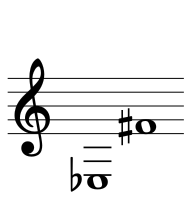
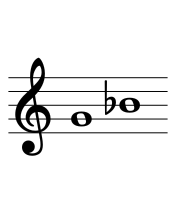
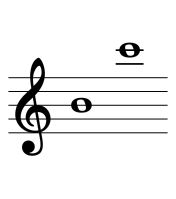
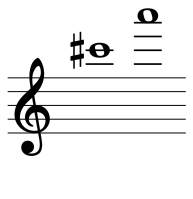
Pitches use scientific pitch notation (C4 is middle C). Its home is the deepest chalumeau imaginable: a cavernous low sound that you feel almost as much as you hear, and that gives the band or orchestra its harmonic floor. Counting the accidentals it produces 43 different pitches in its standard range.
To see how low it goes, here it is next to other low instruments (lowest standard sounding note and approximate frequency):
| Instrument | Lowest sounding note | Frequency |
|---|---|---|
| Bass clarinet | D♭2 (written E♭3) | ~69 Hz |
| Double bass (4 strings) | E1 | ~41 Hz |
| Contrabass clarinet | D♭1 (written E♭3) | ~35 Hz |
| Contrabassoon | B♭0 (written B♭1) | ~29 Hz |
Is the contrabass clarinet played like the clarinet?
Yes: the same Boehm system, the same fingerings and the same treble-clef reading, so any clarinetist can move to it without relearning anything. The differences are in size: the tube is so long that it is folded back on itself, the mouthpiece sits on a metal curved neck, the bell is metal, and the instrument rests on the floor on an endpin (or on a stand) and is played seated. The reed is a single reed, much larger than the one for the B♭ clarinet.
Why is it so big, and where is it used?
To sound one octave below the bass clarinet, you need twice as much tube: unfolded, the contrabass clarinet's tube is well over two meters long. A straight tube that long would be unmanageable, so makers fold it. Some models bend it into the typical "paperclip" shape, others run it vertically with several elbows (as in the photo). Folding does not change the acoustic length of the tube, so the pitch is the same.
It is an uncommon instrument, expensive and bulky, so it appears almost only in large concert bands and wind orchestras, where it reinforces the low register together with the contrabassoon, the bass saxophone, the tubas and the double basses. Makers include Leblanc, Selmer and Buffet Crampon.
Contrabass clarinet fingerings
The fingerings are the clarinet's (Boehm system): six finger holes with rings, the throat keys, the register key and thumb hole on the back, and the little-finger clusters, with the extra key for the low E♭. The pattern repeats a 12th higher with the register key, as on the clarinet.
Choose a note and you will see its fingering, the note on the staff and a real contrabass clarinet sound.
For the fingering logic and the rest of the family, see clarinet notes. Note that the contrabass clarinet sounds far below what the clarinet tuner can read (it works from about 40 Hz up), so tune it by ear against another instrument, or use the tuner with the notes in the upper part of its range.
Common mistakes when learning contrabass clarinet notes
- Counting the transposition wrong. It is not a 9th as on the bass clarinet: it is a major 16th, one octave lower still. To sound in unison with a piano you must read two octaves and a whole step above the piano's pitch.
- Confusing it with the bass clarinet. They look alike, but the contrabass sounds an octave below the bass clarinet and is much bigger.
- Forgetting the low E♭ key. It is like E3 plus the extra little-finger key.
- Starting low notes with too little air. The very long tube needs a lot of air and a relaxed embouchure; squeezing kills the low register, which is the reason for the instrument.
Summary
- The contrabass clarinet is in B♭ and sounds a major 16th below the written note (written C4 sounds B♭1): one octave below the bass clarinet. It reads in treble clef.
- Written range E♭3–A6 (sounding D♭1–G4), about 43 pitches; one of the lowest woodwinds.
- The same Boehm fingerings as the clarinet, plus the low E♭ key.
- A rare instrument of the concert band: it reinforces the bass with the contrabassoon, tubas and double basses.