
The major chord (major triad) is the most stable and recognizable triad in tonal music. It is built with a major 3rd and a perfect 5th above the root, and its sound is bright, open and happy. It is one of the four types of triad, together with the minor, the augmented and the diminished triads. (Spanish textbooks call it the "acorde perfecto mayor", the "perfect major chord".)
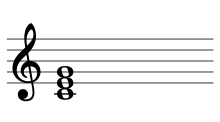
How to build a major chord
Start from the root. Stack a major 3rd (2 whole steps; UK: tones) and, on top of it, a minor 3rd (1½ whole steps). The result is a perfect 5th between the lowest and the highest note. With C as the root:
That major 3rd above the tonic is what makes a melody sound major. To learn to recognize it by ear, try the listening exercise Major or minor?
| Note | Chord member | Interval above the root |
|---|---|---|
| C | Root | — |
| E | Third | Major 3rd (2 whole steps) |
| G | Fifth | Perfect 5th (3½ whole steps) |
The key to its character is the major 3rd: it is what distinguishes the major chord from the minor one, which has a minor 3rd. The perfect 5th, shared by both, gives stability.
Major chord symbol
In lead-sheet chord symbols, the major chord is written simply with the letter of its root, with no added symbol:
| Chord | Symbol |
|---|---|
| C major | C (sometimes CM or Cmaj) |
| G major | G |
| D major | D |
| F major | F |
On which degrees does it appear?
In the major scale, major triads are built on the main degrees: I (tonic), IV (subdominant) and V (dominant). In C major they are C (I), F (IV) and G (V). These three chords define and support the key; much of the repertoire can be harmonized with them alone. To see how each degree is named, see the scale degrees.
If you add a minor 7th above a major triad, you get the dominant seventh chord, the chord of tension and resolution.