
The minor triad (also called the minor chord) is a stable triad with a dark, melancholic or sad sound. It is built from a minor 3rd and a perfect 5th above the root. It is the counterpart of the major triad: both share the perfect 5th, but in the minor triad the 3rd is one half step (UK: semitone) lower. It is one of the four types of triad, along with the major, augmented and diminished triads.
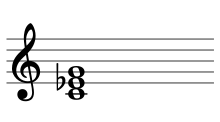
How the minor triad is built
Start from the root. Stack a minor 3rd (3 half steps) and, on top of it, a major 3rd (4 half steps). The result is a perfect 5th between the lowest and the highest note. With C as the root:
| Note | Function | Interval above the root |
|---|---|---|
| C | Root | — |
| E♭ | 3rd | minor 3rd (3 half steps) |
| G | 5th | Perfect 5th (7 half steps) |
Major vs. minor: only the 3rd changes
The only difference between the major and the minor triad is the 3rd. The root and the perfect 5th are the same. What changes the character is whether the 3rd is four half steps above the root (major, bright) or three (minor, dark). So lowering the 3rd by a half step turns a major triad into a minor one:
That 3rd also decides whether a melody sounds major or minor. You can train your ear with the listening exercise Major or minor?
| Triad on C | Notes | 3rd |
|---|---|---|
| Major | C – E – G | Major 3rd |
| Minor | C – E♭ – G | minor 3rd |
Chord symbol for the minor triad
In lead-sheet chord symbols, a minor chord is written with the letter of its root followed by a lowercase "m". A minus sign ("−") is also used:
| Chord | Symbol |
|---|---|
| C minor | Cm (or C−) |
| A minor | Am |
| E minor | Em |
| D minor | Dm |
Where does it appear in the scale?
In the major scale, minor triads are built on scale degrees ii, iii and vi. In C major they are D minor (ii), E minor (iii) and A minor (vi). In the natural minor scale, minor triads appear on the tonic (i), the subdominant (iv) and the dominant (v). These chords give a minor key its characteristic color. To see how each degree is named, read about scale degrees.