
The diminished chord is a triad with a tense, unstable sound. It is built with a minor 3rd and a diminished 5th above the root, which means two minor thirds stacked. The diminished 5th (a half step (UK: semitone) narrower than a perfect 5th) gives it a restless character that tends to resolve. It is one of the four types of triad, together with the major, the minor and the augmented triads.
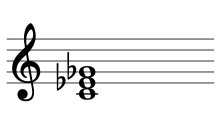
How to build a diminished chord
Stack two minor thirds: one on the root and another on top of it. Between the lowest and the highest note you get a diminished 5th. With C as the root:
| Note | Chord member | Interval above the root |
|---|---|---|
| C | Root | — |
| E♭ | Third | Minor 3rd (1½ whole steps; UK: tones) |
| G♭ | Fifth | Diminished 5th (3 whole steps) |
Compared with the minor triad (C–E♭–G), the diminished chord is identical except that the fifth is lowered a half step (G♭ instead of G). That diminished 5th is the famous tritone, the most tense interval in tonal music.
Diminished chord symbol
In lead-sheet chord symbols the diminished chord is written with the sign "°" (a small circle) or the abbreviation "dim"; "(♭5)" is also seen, though "m(♭5)" is more common in jazz. So the diminished chord on C is written C°, Cdim or Cm(♭5). The table below gives the symbols for all twelve.
The 12 diminished chords
All diminished chords are built the same way: root + minor 3rd + diminished 5th. Here is the reference table with all twelve, their notes and their symbols:
| Chord | Notes | Symbol |
|---|---|---|
| C diminished | C · E♭ · G♭ | C° · Cdim |
| C♯ diminished | C♯ · E · G | C♯° · C♯dim |
| D diminished | D · F · A♭ | D° · Ddim |
| D♯ diminished | D♯ · F♯ · A | D♯° · D♯dim |
| E diminished | E · G · B♭ | E° · Edim |
| F diminished | F · A♭ · C♭ | F° · Fdim |
| F♯ diminished | F♯ · A · C | F♯° · F♯dim |
| G diminished | G · B♭ · D♭ | G° · Gdim |
| G♯ diminished | G♯ · B · D | G♯° · G♯dim |
| A diminished | A · C · E♭ | A° · Adim |
| B♭ diminished | B♭ · D♭ · F♭ | B♭° · B♭dim |
| B diminished | B · D · F | B° · Bdim |
As with the augmented chord, the diminished 5th requires you to keep the letter names right: in F diminished the fifth is C♭, not B, and in B♭ diminished it is F♭, not E, because only then is the interval still a 5th. Roots with sharps (C♯, D♯, F♯, G♯) are usually preferred to their flat equivalents so as to avoid double flats: E♭ diminished would need B double flat.
Diminished chord versus diminished seventh
Do not confuse two similar things:
- The diminished chord is a triad (3 notes): root + minor 3rd + diminished 5th.
- The diminished seventh chord has four notes: the same diminished triad plus a diminished 7th on top.
In other words, the diminished seventh is just the diminished triad with one more note. You can see it next to the others in the summary of seventh chords.
Where does the diminished chord appear?
In the major scale, the diminished chord is built on the seventh degree, the leading tone (UK: leading note): in C major it is B–D–F. In the minor scale it appears on the second degree (and, in harmonic minor, also on the seventh). Its function is always one of tension pushing toward the tonic, thanks to the leading tone and the tritone it contains. To see how each degree is named, see the scale degrees.