
A seventh chord is a four-note chord made by adding one more third on top of a triad: the top note lies a seventh above the root. Its notes are therefore the root, 3rd, 5th and 7th. Seventh chords add more color and tension than triads, and they are the basis of tonal harmony and, above all, of jazz.
The 5 types of seventh chord
Depending on the quality of the triad and of the seventh, there are five main types. All the examples are written on C:
| Type | Structure | Symbol | On C |
|---|---|---|---|
| Dominant seventh | major triad + minor 7th | C7 | C · E · G · B♭ |
| Major seventh | major triad + major 7th | Cmaj7 (CM7) | C · E · G · B |
| Minor seventh | minor triad + minor 7th | Cm7 | C · E♭ · G · B♭ |
| Half-diminished seventh (leading-tone seventh) | diminished triad + minor 7th | Cm7♭5 (Cø7) | C · E♭ · G♭ · B♭ |
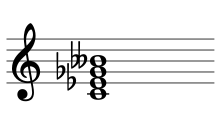
| Diminished seventh | diminished triad + diminished 7th | C°7 (Cdim7) | C · E♭ · G♭ · B double flat |
1. Dominant seventh (C7)
A major triad with a minor seventh. It is the most important seventh chord: built on the fifth degree, its inner tritone "demands" to resolve to the tonic. It is the basis of the V–I cadence. You will find its details, inversions and symbols on the page about the dominant seventh chord.
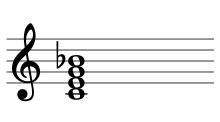
2. Major seventh (Cmaj7)
A major triad with a major seventh. It has a sweet, stable sound and is very typical of jazz and bossa nova. It occurs diatonically on the I and IV degrees of the major scale. → Complete guide to the major seventh chord.
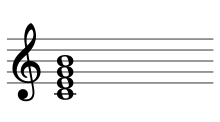
3. Minor seventh (Cm7)
A minor triad with a minor seventh. It has a soft, consonant sound and is the most common seventh chord on the ii, iii and vi degrees of the major scale. → Complete guide to the minor seventh chord.
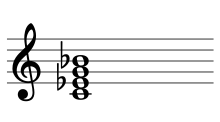
4. Half-diminished (leading-tone) seventh (Cm7♭5)
A diminished triad with a minor seventh. It appears on the leading tone (UK: leading note), the VII degree of the major scale. It is tense, but less so than the fully diminished seventh, because its seventh is minor (not diminished). More details are on the page about the leading-tone seventh chord.
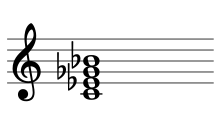
5. Diminished seventh (C°7)
A diminished triad with a diminished seventh. It is symmetrical (all minor thirds) and the most tense of all; it is widely used as a passing chord and to modulate. You will find how it works and its inversions on the page about the diminished seventh chord.
How seventh chords are written
Lead-sheet chord symbols start with the letter of the root and add a suffix for the type: 7 for the dominant seventh (C7), maj7 for the major seventh (Cmaj7), m7 for the minor seventh (Cm7), m7♭5 or ø7 for the half-diminished seventh and °7 or dim7 for the diminished seventh. (In Spanish-, French- and Italian-speaking countries the fixed-do names are used for the notes: C = Do, D = Re, E = Mi, F = Fa, G = Sol, A = La, B = Si.) To review the equivalences, see note names.
Seventh chords of the major scale
Stacking a seventh chord on each scale degree of a major scale gives its diatonic seventh chords. In C major:
| Degree | Chord | Symbol | Type |
|---|---|---|---|
| I | C E G B | Cmaj7 | Major seventh |
| II | D F A C | Dm7 | Minor seventh |
| III | E G B D | Em7 | Minor seventh |
| IV | F A C E | Fmaj7 | Major seventh |
| V | G B D F | G7 | Dominant seventh |
| VI | A C E G | Am7 | Minor seventh |
| VII | B D F A | Bm7♭5 | Half-diminished seventh |