
The minor seventh chord (symbol Cm7) is a four-note chord: a minor triad with a minor 7th added on top. Its sound is dark but soft and stable (it is not a chord of tension), and it is one of the most characteristic sounds of jazz, pop and bossa nova. It is one of the five seventh chords.
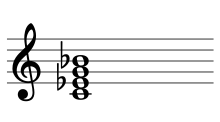
How to build a minor seventh chord
Stack a minor triad (minor 3rd + perfect 5th) on the root and, above it, a minor 7th. With C as the root:
| Note | Chord member | Interval above the root |
|---|---|---|
| C | Root | — |
| E♭ | Third | Minor 3rd |
| G | Fifth | Perfect 5th |
| B♭ | Seventh | Minor 7th |
It differs from the dominant seventh chord in the third (minor instead of major), and from the half-diminished (leading-tone seventh) chord in the fifth (perfect instead of diminished).
Minor seventh chord symbols
| Chord | Symbol |
|---|---|
| C minor seventh | Cm7 · C−7 · Cmin7 |
| D minor seventh | Dm7 |
| A minor seventh | Am7 |
On which degrees does it appear?
In the major scale, the minor seventh chord is built on degrees ii, iii and vi. In C major they are Dm7 (ii), Em7 (iii) and Am7 (vi). It is also the well-known ii chord in the jazz ii–V–I progression.
A note on terminology: "minor seventh chord" is the name used with lead-sheet chord symbols and in jazz. In classical harmonic analysis this chord has no functional name of its own (unlike the dominant seventh or the leading-tone seventh): it is simply the diatonic seventh chord built on degree ii, iii or vi.