
The major seventh chord (symbol Cmaj7) is a four-note chord: a major triad with a major 7th added on top. Its sound is bright, sweet and "floating", very typical of jazz, bossa nova and pop. It is one of the five seventh chords.
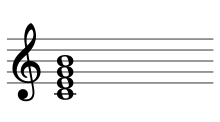
How to build a major seventh chord
Stack a major triad (major 3rd + perfect 5th) on the root and, above it, a major 7th. With C as the root:
| Note | Chord member | Interval above the root |
|---|---|---|
| C | Root | — |
| E | Third | Major 3rd |
| G | Fifth | Perfect 5th |
| B | Seventh | Major 7th |
The key to its color is the major 7th (C–B), only a half step (UK: semitone) below the octave. This sets it apart from the dominant seventh chord, which has a minor 7th (B♭) and sounds tense. The major seventh, in contrast, is stable and bright.
Major seventh chord symbols
| Chord | Symbol |
|---|---|
| C major seventh | Cmaj7 · CM7 · C△7 · Cma7 |
| G major seventh | Gmaj7 |
| F major seventh | Fmaj7 |
On which degrees does it appear?
In the major scale, the major seventh chord is built on degrees I and IV. In C major they are Cmaj7 (I) and Fmaj7 (IV).
A note on terminology: "major seventh chord" is the name used with lead-sheet chord symbols and in jazz. In classical harmonic analysis this chord is simply the seventh chord built on degree I or IV, with no functional name of its own (unlike the dominant seventh or the leading-tone seventh).