
The augmented chord is a triad with a tense, unstable and mysterious sound. It is built with a major 3rd and an augmented 5th above the root, which means two major thirds stacked. The augmented 5th (a half step (UK: semitone) wider than a perfect 5th) takes away the sense of rest and makes the chord "ask" to resolve. It is one of the four types of triad, together with the major, the minor and the diminished triads.
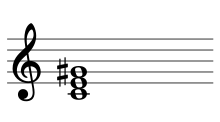
How to build an augmented chord
Stack two major thirds: one on the root and another on top of it. Between the lowest and the highest note you get an augmented 5th. With C as the root:
| Note | Chord member | Interval above the root |
|---|---|---|
| C | Root | — |
| E | Third | Major 3rd (2 whole steps; UK: tones) |
| G♯ | Fifth | Augmented 5th (4 whole steps) |
Compared with the major triad (C–E–G), the augmented chord is identical except that the fifth is raised a half step (G♯ instead of G). That small change completely transforms its character.
Augmented chord symbol
In lead-sheet chord symbols the augmented chord is written with a "+" sign or the abbreviation "aug"; a "(♯5)" or "(5+)" is also seen. So the augmented chord on C is written C+, Caug or C(♯5). The table below gives the symbols for all twelve.
The 12 augmented chords
All augmented chords are built the same way: root + major 3rd + augmented 5th. Here is the reference table with all twelve, their notes and their symbols:
| Chord | Notes | Symbol |
|---|---|---|
| C augmented | C · E · G♯ | C+ · Caug |
| D♭ augmented | D♭ · F · A | D♭+ · D♭aug |
| D augmented | D · F♯ · A♯ | D+ · Daug |
| E♭ augmented | E♭ · G · B | E♭+ · E♭aug |
| E augmented | E · G♯ · B♯ | E+ · Eaug |
| F augmented | F · A · C♯ | F+ · Faug |
| G♭ augmented | G♭ · B♭ · D | G♭+ · G♭aug |
| G augmented | G · B · D♯ | G+ · Gaug |
| A♭ augmented | A♭ · C · E | A♭+ · A♭aug |
| A augmented | A · C♯ · E♯ | A+ · Aaug |
| B♭ augmented | B♭ · D · F♯ | B♭+ · B♭aug |
| B augmented | B · D♯ · F double sharp | B+ · Baug |
Notice that the augmented 5th forces some accidentals that other chords do not need: in B augmented you must use a double sharp (F double sharp), because the note has to keep the letter F for the interval to be a 5th and not a 6th.
Where does the augmented chord appear?
Unlike major and minor chords, the augmented chord does not occur naturally in the major scale. It appears on the third degree of the harmonic minor scale (and of the ascending melodic minor), where the raised leading tone creates the augmented 5th. In practice it is used mostly as a color or passing chord: its characteristic tension resolves well by moving the augmented 5th up to the 6th. To see how each degree is named, see the scale degrees.
Because it is symmetrical (it divides the octave into three equal major thirds), the augmented chord has only four different sounds: every augmented chord is enharmonically equal to two others. In the table above they group like this: C+ = E+ = A♭+; D♭+ = F+ = A+; D+ = G♭+ = B♭+; E♭+ = G+ = B+. They sound the same, but each is spelled differently depending on the key.