
The euphonium (in Spanish, bombardino) is the warm baritone of the brass family: a conical-bore instrument in B♭, related to the tuba but higher, with a round, singing sound. It is one of the leading voices of the concert band, especially in the Valencian tradition. Like the trumpet, it picks a note by combining valves with the harmonics, but it sounds much lower and usually has four valves. In Spanish bands, and in many US bands, it is read at concert pitch in bass clef (it does not transpose). This page gives its notes and fingerings.


| Family | Brass (conical tube) |
|---|---|
| Pitch | B♭ |
| Transposition | None in bass clef (concert pitch: Spanish and most US bands); in treble clef (British brass band, and many US parts) it sounds a major 9th lower than written |
| Range in the table below | B♭1 (pedal tone) to B♭4, sounding; advanced players go higher |
| Valves | 3 or 4 (the 4th opens the low register) |
| Clef | Bass (treble in the British brass band tradition) |
| Also called | Bombardino (Spanish) · euphonium |
Euphonium or baritone horn? The Spanish bombardino is the euphonium. In the US, the baritone horn (often just "baritone") is a different, smaller instrument: also in B♭ and fingered the same way, but with a narrower bore, usually three valves and a lighter sound. The German Baritonhorn is another narrow-bore instrument. Do not confuse bombardon either: in French and German it means a tuba, not a euphonium.
How are the notes produced? Valves and harmonics
The sound starts at the lips, which vibrate against the mouthpiece and produce a series of harmonics. The valves fill the gaps between those harmonics: each one adds tubing and lowers the pitch, as on the trumpet, but starting from B♭.
| Valve | Lowers the note by |
|---|---|
| open (none) | 0 (the harmonic itself sounds) |
| 2nd | 1 half step (UK: semitone) |
| 1st | 2 half steps (a whole step; UK: tone) |
| 3rd (or 1st + 2nd) | 3 half steps |
| 2nd + 3rd | 4 half steps |
| 4th (or 1st + 3rd) | 5 half steps (a perfect 4th) |
| 2nd + 4th | 6 half steps |
| 1st + 4th | 7 half steps |
| 1st + 2nd + 4th | 8 half steps |
For example, the open harmonics of the B♭ euphonium include B♭2, F3, B♭3, D4, F4 and B♭4. Press the 4th valve on F3 and you get C3, a perfect 4th lower.
The fourth valve: the low register
The 4th valve is usually placed at the side and pressed with the left hand on many models. It lowers the instrument by a perfect 4th. It does the same job as 1st + 3rd, but it is better in tune: the 1st + 3rd combination leaves the tubing slightly short, so the note tends to sound sharp. Many four-valve euphoniums are compensating: the extra tubing keeps the low valve combinations in tune. The 4th valve is the key to the low register: combined with the other three valves it reaches the notes below the low E (the table below goes down to B1, with the pedal tone B♭1 below that) and gives alternate fingerings that are better in tune. Three-valve euphoniums do not go as low.
Euphonium, bombardino and the band
In Spain the instrument is called bombardino; in English-speaking countries and most others, euphonium. It is the same instrument: a conical-bore brass in B♭ related to the tuba. It should not be confused with the trombone (cylindrical bore and brighter sound) or with the tuba (larger and lower). In the concert band, the backbone of the Valencian tradition, the euphonium shines in the lyrical melodies of the tenor-baritone register and reinforces the bass line with the tuba. In the British brass band it is also a leading solo voice.
Is the euphonium a transposing instrument?
It depends on the tradition, and this is the most common source of confusion:
- Bass clef, concert pitch. In Spanish bands, in orchestral parts and in many US concert-band parts, the euphonium is read in bass clef exactly as it sounds. It does not transpose. This page uses that notation.
- Treble clef, in B♭. In the British brass band tradition (and in many US band parts, which often supply both versions) the euphonium is written in treble clef as a B♭ transposing instrument, a major 9th below the written note (an octave plus a whole step). A written C4 sounds B♭2.
It is the same instrument and the same fingerings. A given fingering always gives the same sounding pitch; only the notation changes: the treble-clef player reads a note a major 9th higher on the page than the bass-clef player for the same sound.
| Sounding note | On the staffbass clef | Valves1 2 3 4 |
|---|---|---|
| A♯1B♭1 | 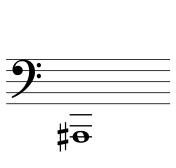 | ○○○○ |
| B1 | 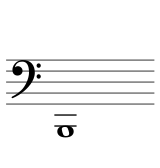 | ●●●● |
| C2 | 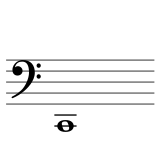 | ●○●● |
| C♯2D♭2 | 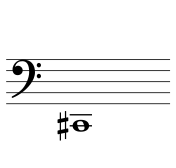 | ○●●● |
| D2 | 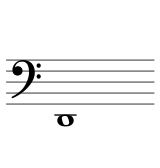 | ●●○● |
| D♯2E♭2 | 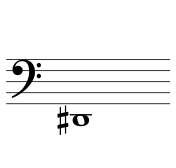 | ●○○● |
| E2 | 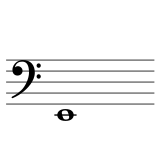 | ○●○● |
| F2 | 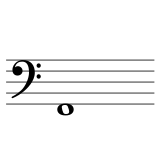 | ○○○● |
| F♯2G♭2 | 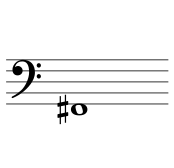 | ○●●○ |
| G2 | 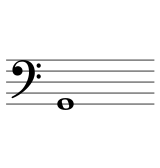 | ●●○○ |
| G♯2A♭2 | 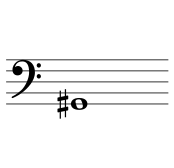 | ●○○○ |
| A2 | 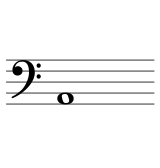 | ○●○○ |
| A♯2B♭2 | 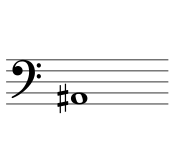 | ○○○○ |
| B2 | 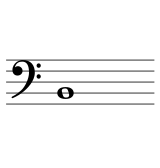 | ○●○● |
| C3 | 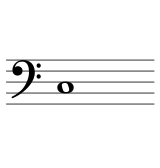 | ○○○● |
| C♯3D♭3 | 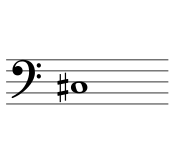 | ○●●○ |
| D3 | 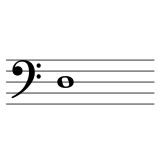 | ●●○○ |
| D♯3E♭3 | 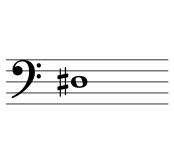 | ●○○○ |
| E3 | 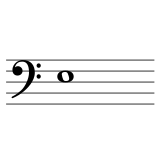 | ○●○○ |
| F3 | 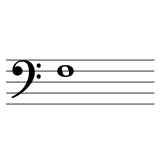 | ○○○○ |
| F♯3G♭3 | 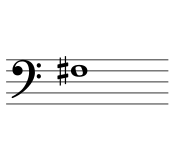 | ○●●○ |
| G3 | 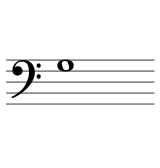 | ●●○○ |
| G♯3A♭3 | 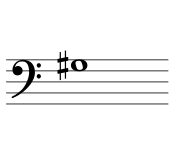 | ●○○○ |
| A3 | 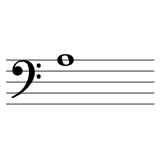 | ○●○○ |
| A♯3B♭3 | 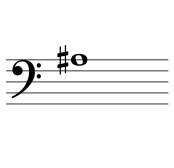 | ○○○○ |
| B3 | 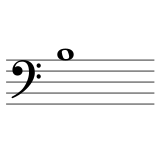 | ●●○○ |
| C4 | 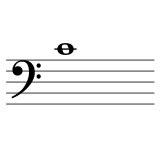 | ●○○○ |
| C♯4D♭4 | 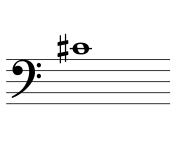 | ○●○○ |
| D4 | 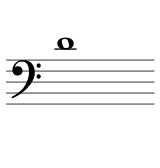 | ○○○○ |
| D♯4E♭4 | 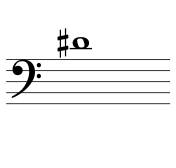 | ●○○○ |
| E4 | 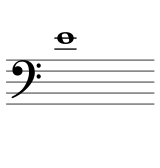 | ○●○○ |
| F4 | 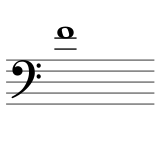 | ○○○○ |
| F♯4G♭4 | 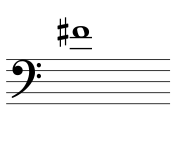 | ●○○○ |
| G4 | 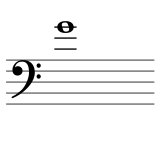 | ○●○○ |
| G♯4A♭4 | 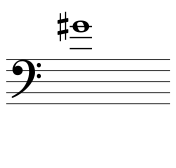 | ○○○○ |
| A4 | 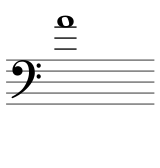 | ○●○○ |
| A♯4B♭4 | 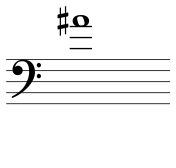 | ○○○○ |
● means the valve is pressed and ○ released, in the order they are under the fingers (1st to 4th). "Open" means no valves: only the lips. Altered notes show their equivalent name below, because F♯ and G♭ are the same note and, depending on the key, you will see one or the other. The notes are written at concert pitch: this is also what sounds. For the treble-clef version, add a major 9th to each note.
Euphonium fingerings
The diagram shows a euphonium with its four valves (three on top and the fourth at the side). When you pick a note, the ones you need to press light up (or none, if it is "open"). As on all brass instruments, one combination serves for several notes: the lips do the rest by adjusting the harmonic.
Pick a note to see its fingering and the note on the staff.
To tune, use the euphonium tuner.
Printable worksheet (PDF)
The same table on paper, on one side of A4 in two columns, for the music stand. And a second sheet to fill in: the 37 notes with the valves column left blank, so you can write the fingering yourself. The reference sheet works as the answer key.

Download the fingerings (PDF) Download the fill-in sheet (PDF)
Common mistakes when learning euphonium notes
- Thinking there is one fingering per note. As on the trumpet, there are few combinations: the same one serves several notes, depending on the harmonic.
- Forgetting the 4th valve in the low register. The lowest notes need it (alone or combined); without it they do not sound or are out of tune.
- Mixing up the clefs. In Spanish bands the part is in bass clef at concert pitch; in the British tradition it is in treble clef, transposed. They are different systems for the same instrument.
- Neglecting the air. The euphonium needs a lot of airflow; its singing sound is sustained by the air column, not by forcing the lips.
Summary
- The euphonium (bombardino) is the conical baritone of the brass in B♭: valves plus harmonics, like the trumpet but lower, and with 4 valves.
- In Spanish bands and many US bands it is read at concert pitch in bass clef (no transposition); in the British tradition it is in treble clef, a major 9th lower than written.
- The 4th valve (a perfect 4th lower, usually at the side) opens the low register.
- It is not the same as the US baritone horn, which is smaller and narrower.