
The tuba is the lowest of the brass instruments: the foundation that the harmony of the concert band and the orchestra rests on. Like the trumpet, it picks a note by combining valves with the harmonics produced by the lips, but it sounds much lower and usually has four valves. Tubas are built in C, B♭, E♭ and F. This page shows the fingerings of the tuba in C, which is read at concert pitch in bass clef (it does not transpose), so the note you read is the note you hear.


| Family | Brass (the lowest) |
|---|---|
| Pitch | C (also called CC); also built in B♭ (BB♭), E♭ and F |
| Transposition | None for the tuba in C: written pitch = sounding pitch |
| Range in the table below | E1–B3 (sounding) |
| Valves | 4 (3 on simpler models, 5 or 6 on professional ones) |
| Clef | Bass |
How are the notes produced? Valves and harmonics
The sound starts at the lips, which vibrate against the mouthpiece and produce a series of harmonics. The valves fill the gaps between those harmonics: each one adds tubing and lowers the pitch, exactly as on the trumpet, but starting from C.
| Valve | Lowers the note by |
|---|---|
| open (none) | 0 (the harmonic itself sounds) |
| 2nd | 1 half step (UK: semitone) |
| 1st | 2 half steps (a whole step; UK: tone) |
| 1st + 2nd | 3 half steps |
| 2nd + 3rd | 4 half steps |
| 4th (or 1st + 3rd) | 5 half steps (a perfect 4th) |
| 2nd + 4th | 6 half steps |
| 1st + 4th | 7 half steps |
| 1st + 2nd + 4th | 8 half steps |
For example, the open harmonics of a tuba in C include C2, G2, C3, E3 and G3. Press the 4th valve on the open G2 and you get D2, a perfect 4th lower.
The fourth valve: the low register
The 4th valve lowers the instrument by a perfect 4th. It does the same job as 1st + 3rd, but it is better in tune: the 1st + 3rd combination leaves the tubing slightly short, so the note tends to sound sharp, while the 4th valve adds the length that is missing. It is the key to the tuba's low register: combined with the other three valves it reaches the lowest notes (the table below goes down to E1 on four valves) and gives alternate fingerings that are better in tune. Three-valve tubas do not go as low, which is why four valves are standard today. Professional tubas often have five or six, which extend the low range and improve intonation further.
C, B♭, E♭ and F: the types of tuba
There is not just one tuba. The most common ones are:
- Tuba in C (CC): the one on this page. Widely used in orchestras and bands; read at concert pitch in bass clef.
- Tuba in B♭ (BB♭): the classic band bass, a whole step lower than the tuba in C. Its fingerings are different.
- Tuba in E♭ (EE♭): very common in bands, a perfect 4th higher than the tuba in B♭.
- Tuba in F: higher and more agile than the tuba in C (a perfect 4th above it). Often used as a second tuba and for solo work.
The valves can be piston valves or rotary valves. The mechanism changes, but the fingering logic is the same.
Is the tuba a transposing instrument?
It depends on the tradition. In orchestras and in most wind bands (including the Spanish and US bands), the tuba is read at concert pitch in bass clef, whatever its tuning: the player uses the fingerings of their own instrument for the notes that sound. The tuba in C on this page needs no transposition at all. In the British brass band tradition, in contrast, the E♭ and B♭ basses are written in treble clef as transposing instruments: the E♭ bass sounds a major 13th (an octave plus a major 6th) below the written note, and the B♭ bass a major 16th (two octaves plus a whole step) below it. It is the same instrument, read in a different way.
The tuba in the band and the orchestra
The tuba is the base of the sound. In the concert band, which is the backbone of the Valencian tradition, it supports the harmony and plays the bass line of the pasodoble and the march. In the orchestra it anchors the brass section together with the bass trombone. Its large conical tube gives a round, deep sound that can fill a whole hall from the lowest register.
A symphonic band usually has one to four tubas, depending on its size. An orchestra normally has just one (some works ask for two). In everyday writing a tuba in C covers roughly E1 to F4 on four valves, and professionals extend it at both ends: the fifth and sixth valves and pedal tones go lower still. One fact that surprises many people: although it is the lowest brass instrument, its unwound tubing is about five meters long (around 16 ft) on a tuba in C, and longer on a tuba in B♭ (about 5.5 meters).
| Note | On the staffbass clef | Valves1 2 3 4 |
|---|---|---|
| E1 | 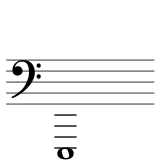 | ●●○● |
| F1 | 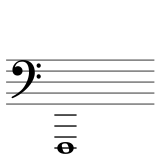 | ●○○● |
| F♯1G♭1 | 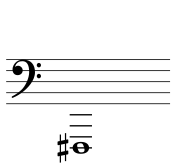 | ○●○● |
| G1 | 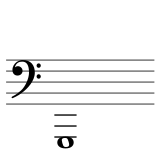 | ○○○● |
| G♯1A♭1 | 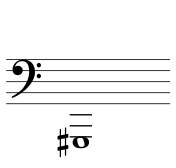 | ○●●○ |
| A1 | 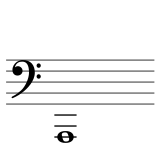 | ●●○○ |
| A♯1B♭1 | 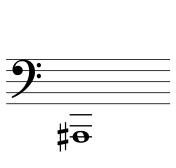 | ●○○○ |
| B1 | 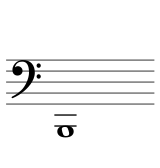 | ○●○○ |
| C2 | 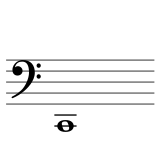 | ○○○○ |
| C♯2D♭2 | 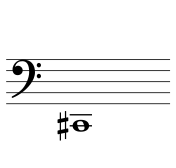 | ○●○● |
| D2 | 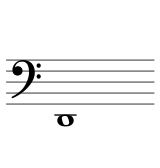 | ○○○● |
| D♯2E♭2 | 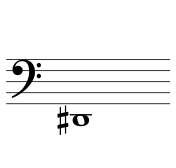 | ○●●○ |
| E2 | 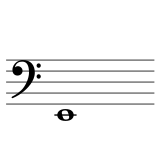 | ●●○○ |
| F2 | 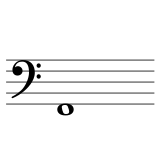 | ●○○○ |
| F♯2G♭2 | 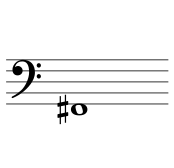 | ○●○○ |
| G2 | 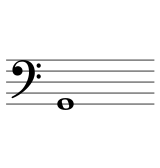 | ○○○○ |
| G♯2A♭2 | 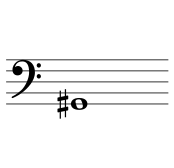 | ○●●○ |
| A2 | 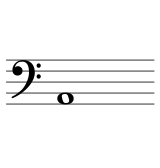 | ●●○○ |
| A♯2B♭2 | 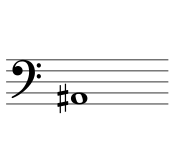 | ●○○○ |
| B2 | 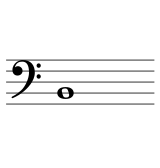 | ○●○○ |
| C3 | 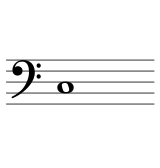 | ○○○○ |
| C♯3D♭3 | 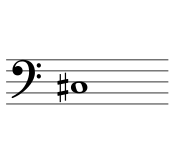 | ●●○○ |
| D3 | 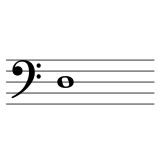 | ●○○○ |
| D♯3E♭3 | 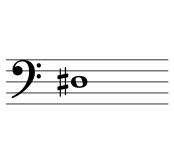 | ○●○○ |
| E3 | 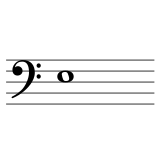 | ○○○○ |
| F3 | 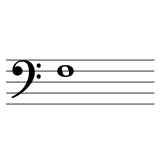 | ●○○○ |
| F♯3G♭3 | 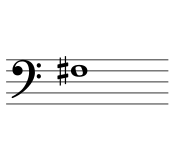 | ○●○○ |
| G3 | 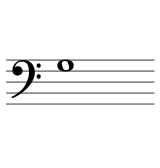 | ○○○○ |
| G♯3A♭3 | 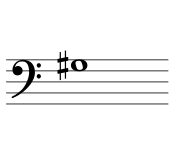 | ●○○○ |
| A3 | 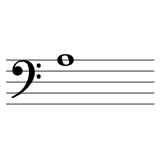 | ○●○○ |
| A♯3B♭3 | 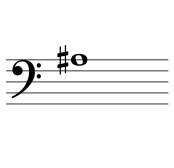 | ○○○○ |
| B3 | 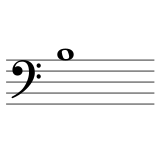 | ○●○○ |
● means the valve is pressed and ○ means it is up, in the order the valves lie under your fingers (1 to 4). “Open” means no valves: only the lips change the note. Altered notes show their enharmonic name underneath, because F♯ and G♭ are the same pitch and, depending on the key, you will see one or the other.
Tuba fingerings
The table above gives the valve combination for each note, from E1 to B3. Remember that one combination serves several notes: the lips pick the harmonic, and the valves lower it. As on the rest of the brass family, many notes share the same fingering. The tuba in B♭, E♭ or F uses different fingerings from the ones shown here.
The diagram shows a tuba with its four valves in the middle. When you pick a note, the valves you need to press light up (or none, if it is "open"). As on the whole brass family, one combination serves for several notes: the lips do the rest by adjusting the harmonic.
Pick a note to see its fingering, the note on the staff and its real tuba sound.
Printable worksheet (PDF)
The same table on paper, on one side of A4 in two columns, for the music stand. And a second sheet to fill in: the 38 notes with the valves column left blank, so you can write the fingering yourself. The reference sheet works as the answer key.

Download the fingerings (PDF) Download the fill-in sheet (PDF)
Common mistakes when learning tuba notes
- Thinking there is one fingering per note. As on the trumpet, there are few combinations: the same fingering gives several notes depending on the harmonic.
- Ignoring the 4th valve in the low register. Many low notes need the 4th valve (alone or combined); without it they are out of tune or do not speak at all.
- Mixing up the fingerings of different tubas. The fingerings of the tuba in C do not work on a tuba in B♭ or F; use the ones for your own instrument.
- Neglecting the air. The tuba needs a large, steady flow of air; a powerful, in-tune low register comes from the air column, not from forcing the lips.
In short
- The tuba is the bass of the brass: valves plus harmonics, like the trumpet but much lower, usually with four valves.
- It comes in C, B♭, E♭ and F. This page shows the tuba in C, read at concert pitch in bass clef (no transposition).
- The 4th valve (a perfect 4th down) opens the low register and gives better-tuned alternatives.
- It is the harmonic foundation of the band and the orchestra.