
Modulation is a change from one key to another within the same piece, so that the new key settles in as the tonal center. It is not enough for a few notes outside the key to appear: the music “moves house” to a new tonic and stays there for a while, normally confirmed by a cadence. The three main types are diatonic (through a common chord), chromatic and enharmonic.
What is modulation?
A piece in C major has its center on the note C: everything revolves around that tonic (see harmonic functions). To modulate is to move to another center, for example G major, so that G is now the note of rest and F is heard as F♯, because it is the leading tone (UK: leading note) of the new key.
Composers modulate to add variety, to create contrast between sections, and to surprise or intensify. In classical sonatas and symphonies, for example, the exposition usually moves from the home key to the key of the dominant (or, if the piece is in minor, to its relative major).
Modulation or a passing accidental?
Not every chord with a new accidental is a modulation. If the new center lasts only a moment and is not confirmed by a cadence, most authors speak of a tonicization or a secondary dominant: the music “points” to another tonic but does not settle there. In a modulation, by contrast, the new key is established.
How a modulation happens
In many modulations you can tell three moments apart (not all have them so clearly, as in direct modulation):
- Initial key: the starting key is established with its chords.
- Transition chord: a chord (or an altered note) that links the two keys.
- Cadence in the new key: the dominant and tonic of the new key confirm it.
Types of modulation
Diatonic modulation (common chord or pivot chord)
It relies on a pivot chord (or common chord): a chord that belongs to both keys and can be understood in either. It is “read” first in the starting key and then in the new one, so the music passes from one to the other smoothly. It usually produces a fluid transition between keys and is very common in tonal harmony.

In the example, the A minor chord (A–C–E) belongs to both keys: in C major it is vi and in G major it is ii. The F♯ in the next chord is the leading tone of G and signals the change of key.
Chromatic modulation
In chromatic modulation, a note of a chord in the starting key is altered with a sharp, flat or natural, and that chromatic change turns the chord into another one (for example, the dominant of the new key). No common chord is needed: the alteration acts as the bridge.

Here the C natural of the A minor chord rises to C♯: that chromatic half step (UK: semitone) turns the chord into V7 of D major (A–C♯–E–G), and C♯ is the leading tone of D. That is why the ear hears the change of key. Even so, the C♯ alone does not prove a modulation: what confirms it is the V7–I in D major and D being established as the new tonal center.
Enharmonic modulation
In enharmonic modulation, a chord is reinterpreted by changing the way one of its notes is written (and understood) to another note that sounds the same. The classic case is the diminished seventh chord: because it is made of three stacked minor thirds, each of its notes can be the leading tone of a different key.
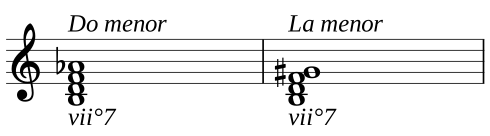
A♭ and G♯ are the same key on the piano: the pitch is the same, but depending on how the chord is written it leads to C minor or to A minor. B–D–F–A♭ is vii°7 of C minor in root position; in A minor the leading-tone chord is built on G♯ (G♯–B–D–F), so B–D–F–G♯ is that same chord with G♯ on top (first inversion). What changes is not a note but the spelling and, with it, the function. This modulation was widely used in the Romantic era to reach distant keys.
Another form: direct modulation
Some authors add direct modulation (also called phrase modulation or by juxtaposition): the music moves to the new key without preparation, simply by starting a phrase in it. It is the most abrupt and is noticed immediately.
Which keys do we modulate to?
The most natural modulations go to the neighboring keys, which share almost all their notes with the starting key (they differ by one accidental at most) and allow smooth transitions: the dominant, the subdominant, the relative key, and the relatives of the dominant and subdominant. From C major:
| Neighboring key | Relation to C major | Accidentals |
|---|---|---|
| G major | Dominant | 1 sharp |
| F major | Subdominant | 1 flat |
| A minor | Relative minor | None |
| E minor | Relative of the dominant | 1 sharp |
| D minor | Relative of the subdominant | 1 flat |
In major, the most frequent are the dominant and the relative minor; in minor, the relative major and the dominant. The circle of fifths helps you see which keys are close.
How to recognize a modulation in a score
- Look for new accidentals or notes that point to another key. They are a clue, not proof: a secondary dominant also brings a foreign leading tone.
- Check whether the chords can be interpreted in the new key and find the pivot chord, the one that can be analyzed in both.
- Listen for a cadence on the new tonic that confirms the new tonal center.
- Judge whether the music stays in that key or only tonicizes it for a moment. If it is a modulation, the pivot chord is analyzed with a double label (vi = ii).
If the new key lasts a long time, the key signature is often changed in the score; if it lasts only briefly, writing accidentals is enough.
Common mistakes
- Thinking an isolated accidental is a modulation. The new key must be established; one foreign note is not enough.
- Forgetting the cadence. Without a cadence confirming the new tonic, the change is usually passing.
- Confusing modulation with a change of mode. Going from C major to C minor changes the mode but keeps the tonic; to modulate is to change the tonic.
- Thinking every key-signature change is a modulation. Usually it is, but the criterion is by ear and harmony: the new tonic must be heard as the center.